


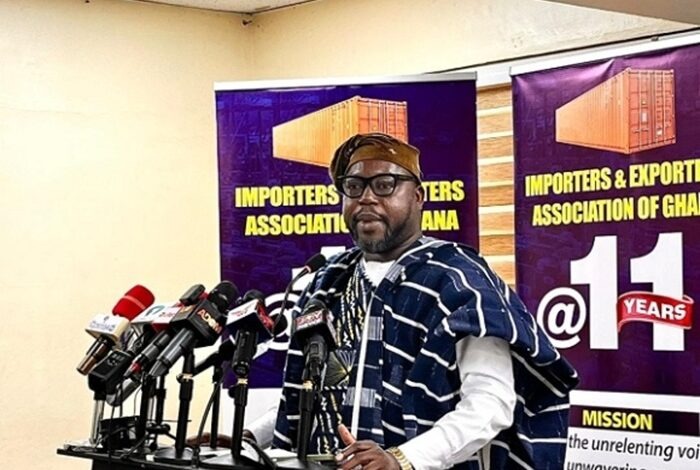
The Importers and Exporters Association of Ghana (IEAG) has dismissed claims by two civil society organisations (CSOs) that the Integrated Customs Management System (ICUMS), is dysfunctional and causing revenue losses.

In a press statement signed by the Executive Secretary Samson Asaki Awingobit, the Association said it was “necessary to set the records straight” after the New Voter Forum and Democratic Credentials Network Ghana held a press conference criticising ICUMS and port operations.
“Since its introduction in June 2020 by the Government of Ghana through the Ghana Revenue Authority (GRA), the Integrated Customs Management System (ICUMS) has become the backbone of customs administration and trade facilitation in Ghana,” the statement said.
The IEAG argued that ICUMS has improved customs processes, risk management and revenue assurance.
“The suggestion by the CSOs that ICUMS is a dysfunctional system breeding national loss is not supported by empirical evidence and runs contrary to the actual experiences of many traders, freight forwarders, customs brokers and industry stakeholders who interact with the system daily.”
Citing official data, the Association said customs revenue rose from GH¢30.6 billion in 2023 to about GH¢44.3 billion in 2024.
It added that “customs revenue exceeded US$3.17 billion by September 2025,” while over GH¢120 billion has been mobilised through ICUMS since rollout.
“These achievements cannot reasonably be reconciled with the narrative that ICUMS is causing revenue losses to the state.”
On alleged system downtimes, IEAG said no digital platform was immune from occasional interruptions, but “portraying such incidents as systemic failure is both unfair and inaccurate.”

The statement noted that Ghana Link Network Services has “consistently upgraded the system to improve performance, processing speed, cybersecurity protection and operational resilience.”
The Association said one major gain from ICUMS was reduced human interference. “Through automation, electronic documentation, digital payment systems, integrated risk management and cargo tracking functionalities, opportunities for discretionary decision-making and revenue leakages have been substantially minimised.”
IEAG also defended LCB Worldwide Ghana Limited, which handles disinfection services at ports under Ghana Health Service (GHS) supervision. It described attacks on the company as “unfair and unsubstantiated.”
“As a major stakeholder in Ghana’s international trade ecosystem, IEAG can state without hesitation that the services provided by LCB Worldwide have become an important component of Ghana’s border health security architecture,” the statement said.
It added that the COVID-19 pandemic showed the need for “robust preventive measures to protect both public health and commercial interests.”
“Contrary to the impression created by the CSOs, the implementation of port disinfection services has not hindered trade activities. Rather, it has strengthened Ghana’s preparedness against biological threats and enhanced confidence in the safety and integrity of Ghana’s trade corridors.”
While backing constructive criticism, the Association cautioned against “conjecture, sensationalism and politically coloured narratives.”
It urged stakeholders to “engage responsibly and avoid creating unnecessary uncertainty within Ghana’s international trade environment.”
The IEAG commended government, GRA, Customs Division, Ghana Link Network Services, Ghana Health Service and LCB Worldwide for their roles in improving trade facilitation.
It called for more support for system upgrades, cybersecurity, stakeholder training, and port health infrastructure.
“The future of Ghana’s international trade depends on modernisation, digitisation, innovation and strong institutional collaboration,” the statement said.
“ICUMS represents one of the most important digital reforms undertaken within Ghana’s customs administration framework, while the port disinfection programme remains a critical pillar of Ghana’s border health security system.”


