


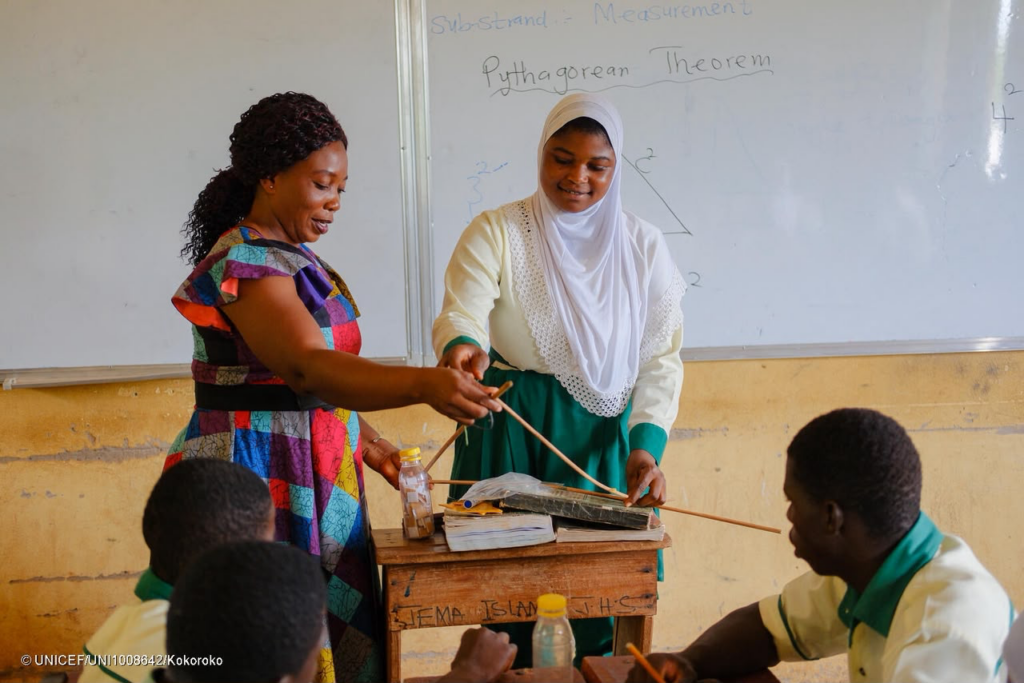
A new government-backed report has revealed significant inequalities in the distribution of teachers across Ghana’s public basic schools, warning that staffing shortages are affecting learning outcomes despite high school enrolment rates.

The Teachers for All (T4A) Ghana Report, launched by the Ministry of Education with support from UNICEF, the UK Foreign, Commonwealth and Development Office (FCDO) and other partners, examines teacher deployment nationwide and proposes reforms to improve equitable staffing.
According to the report, Ghana has achieved near-universal access to basic education, with gross enrolment rates reaching 99.6% at the primary level and 98.4% at the junior high school level during the 2022/23 academic year.
However, learning outcomes remain weak. Results from the 2024 National Standardised Test showed that 45.27% of pupils scored below basic proficiency in Mathematics, while 50.33% fell below the benchmark in English.
The report identifies unequal teacher deployment as a major contributor to these poor outcomes.
It found that around one in five districts faces severe teacher shortages, with average pupil-teacher ratios exceeding the Ministry of Education’s target of 35 pupils per teacher. Rural communities are the most affected, particularly in the North-East, Savannah and Northern regions, where pupil-teacher ratios stand at 48:1, 41:1 and 39:1 respectively.
The report also notes that rural schools struggle to attract and retain female teachers due to challenges such as poor transportation, safety concerns and inadequate sanitation facilities.
To address the disparities, the report recommends using data-driven teacher deployment to direct staff to underserved schools, while introducing stronger incentives to attract and retain teachers in hard-to-reach communities.
It also calls for targeted measures to support female teachers, including family-friendly policies, leadership opportunities and stronger protections against discrimination and gender-based violence.
According to the report, improving teacher deployment is essential to reducing class sizes, strengthening literacy and numeracy, and expanding access to female role models in schools.
It further notes that with about 84% of the Ministry of Education’s 2026 budget allocated to teacher compensation, deploying teachers more effectively is critical to maximising the value of public investment in education.


