


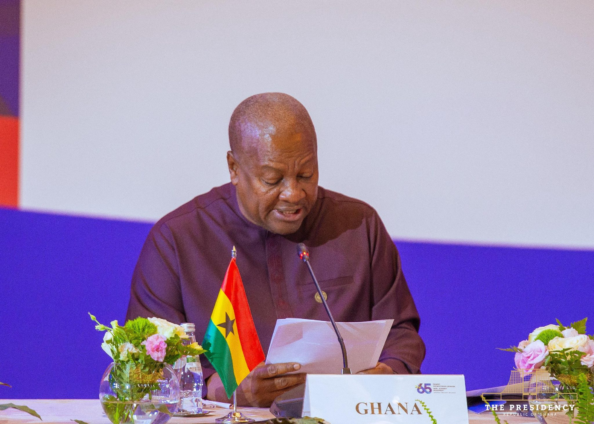
President John Dramani Mahama has warned that government will no longer continue absorbing persistent financial losses incurred by State-Owned Enterprises (SOEs), urging their boards and management teams to improve efficiency, accountability and profitability.

Speaking at a conference organised by the State Interests and Governance Authority (SIGA) at the La Palm Royal Beach Hotel, President Mahama said his administration had reset its relationship with SOEs and would demand greater value from institutions entrusted with managing public assets.
He said the continued dependence of state-owned enterprises on government support placed an unnecessary strain on the national budget and could no longer be sustained.
“Persistent losses will no longer be quietly absorbed into the national budget,” President Mahama said.
Performance must determine leadership
The President said leadership positions in SOEs must be tied to measurable performance, value creation and profitability.
He reminded boards, chief executives and management teams that the assets under their control ultimately belonged to the people of Ghana and were being held in trust on their behalf.
President Mahama cited the country’s ports, power infrastructure, factories, water systems, pension funds, lands, buildings, equipment and government-owned shares among the public assets entrusted to state-owned enterprises.
“These assets do not belong to any government, a board, or a chief executive. They belong to the people of Ghana, and you and I hold them only in trust for the people,” he said.
Public ownership must deliver value
According to President Mahama, the central principle guiding the conference was that public ownership must translate into tangible public value.
He therefore challenged every institution represented at the gathering to provide credible evidence of the value it had created for the Ghanaian people.
The President’s remarks underline his administration’s expectation that SOEs must operate more efficiently, strengthen accountability and reduce their reliance on government funding while delivering measurable returns on the public assets placed under their management.


