


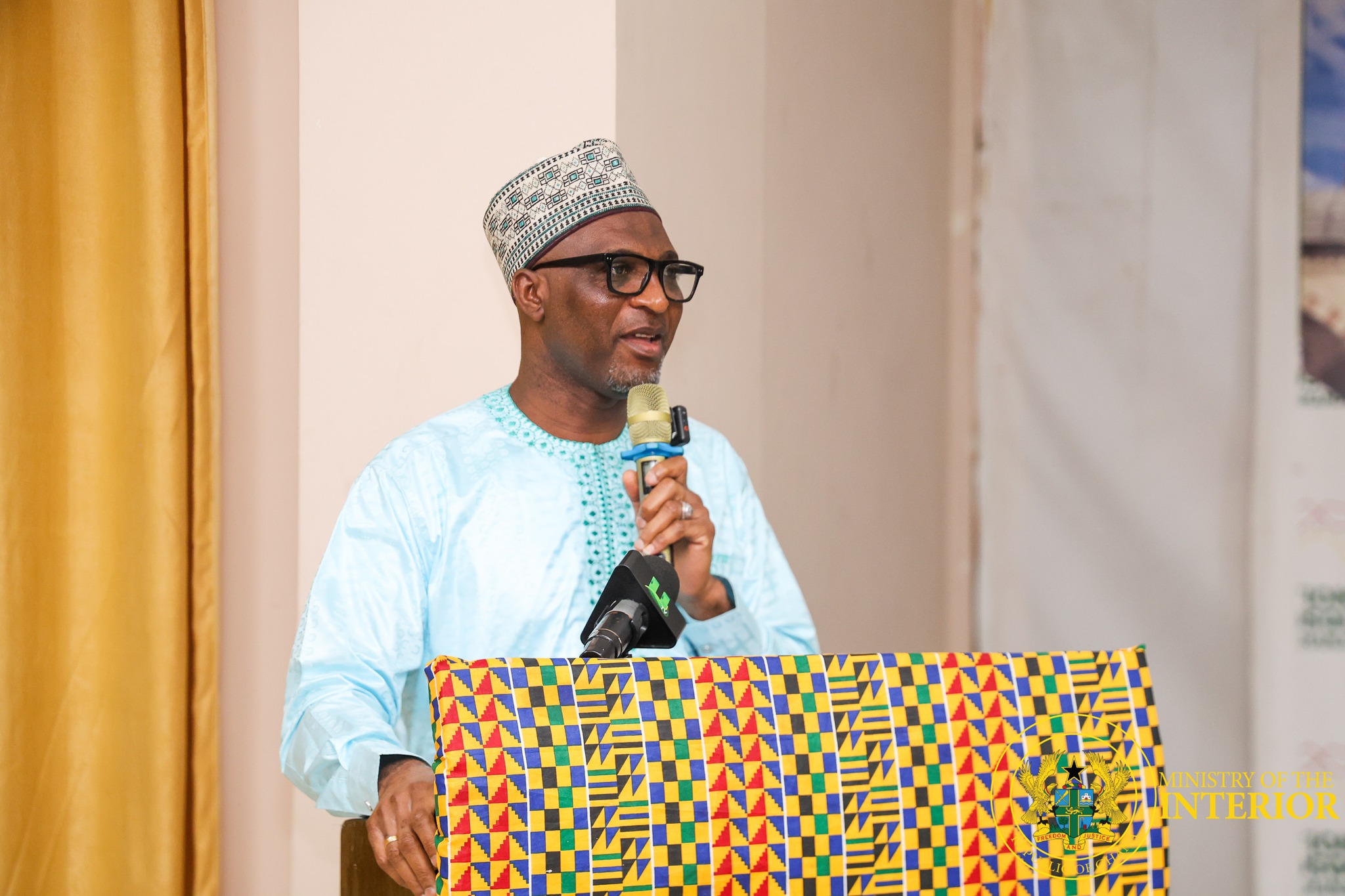
The Minister for the Interior, Mubarak Mohammed Muntaka, has identified ethnic conflicts, land disputes and illicit drug trafficking as major security challenges facing Ghana, despite an improvement in the country’s overall security situation.

Speaking on Joy FM’s Super Morning Show on Monday, October 12, 2026, the minister said insecurity in the Sahel and the country’s porous borders continued to pose significant challenges to security agencies.
Asked about the major threats requiring urgent attention, Mr Muntaka highlighted communal conflicts, disputes over land ownership and the trafficking of narcotics.
He expressed particular concern about the use of West Africa’s coastline as a transit route for illicit drugs, citing findings by the United Nations Office on Drugs and Crime (UNODC).
“You come and inherit a situation where the UN Office on Drug and Crime has consistently showed that in the last, probably, decade, the West Coast is being used as transit point for illicit drugs,” he said.
The minister also pointed to instability in the Sahel, noting that some countries in the region struggled to maintain effective control over substantial portions of their territory.
“I can tell you that, without mentioning specific countries, some of them don’t control up to 60% of their area,” he stated.
According to Mr Muntaka, addressing these regional threats requires stronger cooperation among neighbouring countries, particularly in intelligence sharing and coordinated security operations.
He said he maintained direct contact with interior and national security ministers across the sub-region to facilitate collaboration.
“So there’s no interior or national security minister in the sub-region that I don’t have direct contact with,” he said.
“You have to try and share intelligence, you have to work together. As difficult as it is, sometimes there’s mistrust and all that.”
More than 300 unapproved border crossing points
Mr Muntaka said Ghana’s border arrangements presented additional difficulties for security agencies, particularly in communities where residents routinely cross into neighbouring countries for farming, trade and other daily activities.
He explained that the boundaries between some communities and neighbouring countries made it difficult to monitor movement effectively.
“So you could farm in one country and sleep in another country based on the way they’ve done it,” he said.
The minister disclosed that Ghana had 48 approved border crossing points but more than 300 unapproved routes through which people could enter or leave the country.
“The legitimate crossing points are 48,” he said, adding, “We have over 300 illegitimate crossing points.”
He indicated that the number of unofficial routes complicated border surveillance and efforts to prevent illicit activities.
Bawku conflict puts pressure on security agencies
On internal security, the minister recalled the escalation of violence associated with the Bawku conflict in 2025, which he said extended beyond the immediate conflict area and required security operations and mediation efforts.
He cited retaliatory attacks, including the burning of buses along highways, as examples of the incidents that placed considerable pressure on the authorities.
“I mean, and I can bet you, these were periods that I could hardly sleep,” he said.
Despite the challenges, Mr Muntaka maintained that the security situation had improved.
He cited 150 days without gunfire in Bawku and a reduction in the number of curfews across the country from approximately nine at the end of 2025 to three.
“Ghana is much safer even today than it was in 2025,” he said.
The minister added that the government and security agencies were continuing efforts to strengthen public safety and enable residents to carry out their daily activities without fear.
“We are doing everything possible to ensure that you can go about your duties without necessarily having to be watching your back,” he stated.


