


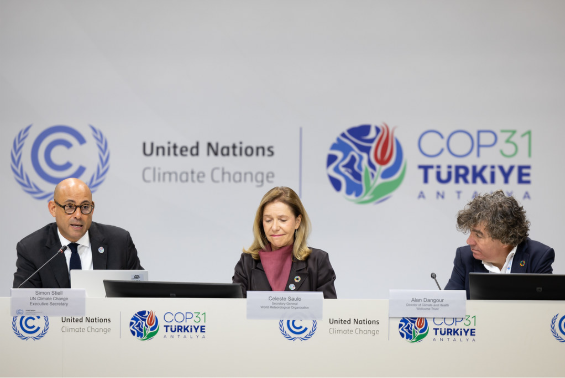
The climate crisis is now a global health crisis of pandemic proportions. That was the blunt warning from UN Climate Change Executive Secretary, Simon Stiell, at a press conference at COP31 in Antalya, as the World Meteorological Organization (WMO) released its State of the Climate Update 2026.

“For too many people, climate change is deadly,” Stiell said. “A super El Niño is turbocharging climate impacts, delivering a deadly double-blow.”
He pointed to hundreds of millions of people exposed to extreme heat across southern Asia, and heatwaves in the northern summer that smashed temperature records and killed an estimated 50,000 people across Europe.
Heat And Pregnancy: An Unfolding Disaster
Stiell singled out the impact of rising heat on pregnancy, newborns and maternal health as “another unfolding health disaster which has the fingerprints of the climate crisis all over it.”
“The root cause is humanity still burning colossal amounts of coal, oil and gas, and destroying forests,” he said.
He said health will again be central at this COP, under Türkiye and Australia’s guidance, building on progress made at COP30 in Belém. That includes through the Climate & Health Funders Coalition, which has already awarded more than $200 million.
WMO: No End In Sight
WMO Secretary-General Celeste Saulo said the science is “extremely robust” – and the records keep breaking.
“The past 12 years have been the warmest on record. The past four years – including 2026 – are the top four,” Saulo said.
From January to September, the global average temperature was about 1.47°C above the pre-industrial average. With the strong El Niño factored in, temperatures are likely to rise further for 2026 as a whole.
She warned that El Niño usually has its greatest impact the year after it develops – which is why 2024 was the warmest year on record, and why 2027 could break records again.
“This 2026/2027 El Niño is off the charts. It is different from any El Niño that we have monitored,” she said.
The WMO declares an El Niño when sea surface temperature is 0.5°C above average in the Tropical Pacific.
Saulo said it could reach nearly four times that level between November 2026 and January 2027.
Other findings: Ocean heat is the highest on record for the tenth consecutive year.
Sea-surface temperatures hit monthly records during 2026.Sea level has reached a record high, increasing risks for 900 million people living along low-lying coasts.
“We are super-charging our weather,” Saulo said. “Heatwaves, tropical cyclones, and rainstorms are intensifying faster than our historical baselines prepared us for.”
She pointed to devastating floods in parts of South America and Africa, drought in Asia, the Pacific and Central America and the catastrophe in China and Nepal that showed the dangers of high-mountain disasters.
But she also offered hope: the number of countries reporting multi-hazard early warning systems has increased from 56 in 2015 to 136 in 2025.
“We cannot afford to fly blind,” she said.
Wellcome: People Are The Main Character
The Director of Climate and Health at Wellcome, Alan Dangour, said the WMO report makes “sombre reading” – highest ever greenhouse gas concentrations, record heat on land and ocean, alarming sea-ice melt and sea level rise and a catastrophic El Niño.
“But the main character at the centre of this story is not the atmosphere, the land, the ocean or the ice – it’s us,” Dangour said.
“You and me, your family and your community.”
Citing The Lancet Countdown, he said burning fossil fuels and human-caused climate change is estimated to kill over 3 million people each year from fossil-fuel related air pollution and extreme heat.
Extreme drought affected nearly 52% of the world’s land for at least a month in 2025 – the second-highest level on record – affecting farmers, outdoor workers, food security and sanitation.
But Dangour said solutions are already working: Cleaner air is preventing over 300,000 deaths a year in at least 77 countries.
Electrification and cleaner energy will save lives and reduce healthcare costs. Heat early warning systems are already preventing deaths.
Adaptation is cheaper than paying later.
He announced that the Climate & Health Funders Coalition – formed at COP30 in Belém with over 35 philanthropies and an initial $300 million commitment – has awarded more than $225 million in its first year for extreme heat, air pollution, climate-sensitive infectious diseases and data systems.
It has also attracted an additional $150 million in new commitments. On pregnancy and heat, Dangour said Wellcome and partners launched a global call to action at the Pre-COP31 in Fiji to ensure health guidelines, information, plans and data to protect pregnant women from extreme heat.
“We must change course and put the health and wellbeing of people at the heart of our response to climate change – measuring success not through emissions targets or degrees Celsius but by lives saved and health outcomes improved,” he said.
Electric Or Shock
Stiell closed with a choice for nations at COP31: “electric or shock.”
“Rewire the global economy for the electric age. Or accept ongoing fossil fuel cost pain for families, firms and governments and of course that includes health systems,” he said.
“Efficient electrotech and clean energy are a vital cure for planet-heating pollution and spiraling household costs.”
He apologised for leaving before questions, saying he would take questions at a full press conference with the Presidency tomorrow.


