


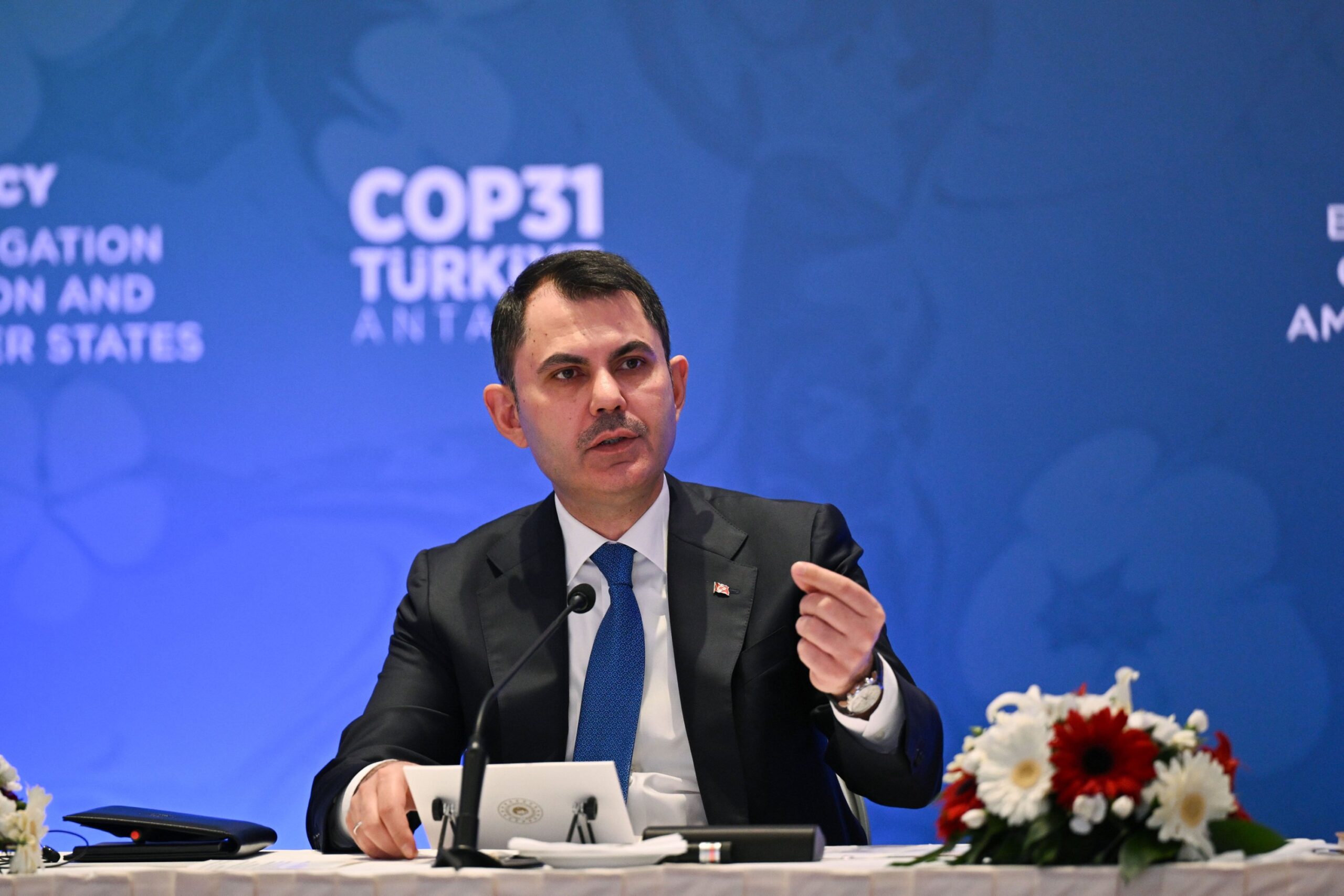
The world has entered the age of electricity. That was the message from the COP31 Presidency on Monday as countries, businesses and investors rallied behind Türkiye’s push to electrify the global economy – from transport and buildings to industry.

At the heart of the push is the COP31 Global Electrification Pledge, which aims to raise electricity’s share of final energy consumption from around 23% today to 35% by 2035 – the “35-by-35” target. The target, based on analysis by the International Energy Agency (IEA) and the International Renewable Energy Agency (IRENA), is designed to keep the world on a pathway consistent with limiting warming to 1.5°C above pre-industrial levels, while improving energy security, expanding energy access, and cutting costs and emissions.
“We flicked the switch”COP31 President Murat Kurum said the world could no longer afford to treat electrification as an afterthought. “We need the 35-by-35 target because until now electrification has not been underpinned by a clear global goal. This year’s energy crisis has shocked us out of our complacency and demonstrated the inherent vulnerability of dependence on energy imports. Electrifying the global economy is now essential to boost energy security, cut emissions, and drive economic growth.”
“The COP31 Presidency is determined to chart a path forward and use the annual UN summit to build momentum. We are bringing everyone together to support each other and build collective momentum. The age of electricity is taking shape – and COP31 will be remembered as the moment we flicked the switch. “COP31 President of Negotiations, Chris Bowen, said ambition must now be matched with delivery:
“At COP31, we are seeking broad support for faster electrification, matched by practical delivery pathways. When electrification is backed by clean power, stronger grids and storage, it can improve energy access, strengthen energy security and cut emissions across households, transport and industry. The global clean energy transition is well underway and the task at COP31 is to accelerate it. Ambition matters, but it must be backed by investment, infrastructure and implementation.” “We need to shift electricity from a fifth to a third of global energy consumption.”
A new Electrification Forum
On Monday afternoon, the COP31 Presidency co-hosted the first Electrification Forum with the European Union.The Forum will continue beyond COP as a regular meeting of governments, institutions, businesses and financiers. It will be run by the Electrification Board, chaired by the COP31 Presidency with the IEA acting as its secretariat.
The IEA will also lead the Global Electrification Tracking Mechanism to monitor global and regional electrification trends. IEA Executive Director, Dr. Fatih Birol, said: “Electric technologies are often cost-competitive and can improve energy security for fuel importers.
COP31 is an important opportunity to strengthen the global focus on electrification, and the IEA is pleased to be supporting the Presidency including through our data-driven analysis that underpins the 35-by-35 Pledge. We look forward to maintaining momentum as custodian of the Electrification Forum and of tracking progress in the years to come.”IRENA will support the Presidency with the Enabling Distribution Grids for Electrification (D-GRIDS) programme to help developing countries identify grid investment needs, prepare projects and access finance.
IRENA Director-General, Francesco La Camera, said: “The 35-by-35 Global Electrification Pledge is firmly grounded in IRENA’s analysis and we are pleased to support the COP31 Presidency. I am particularly pleased that IRENA has been entrusted with leading D-GRIDS, the infrastructure pillar of the Global Electrification Initiative, to strengthen distribution grids and unlock electrification. Together with our partners, and the IRENA-guided Utilities for Net Zero Alliance, we will accelerate grid development, integrate more renewable power and advance electrification worldwide.”Utilities raise investment to $156bnThe Utilities for Net Zero Alliance (UNEZA) announced an increase in its annual grid, renewables and storage investment commitment from $148 billion to $156 billion.Martin Pibworth, Chief Executive at SSE plc and UNEZA co-chair, said:”Clean electrification is the pathway not just to decarbonisation but to lower bills, energy security and resilience.
The COP31 35-by-35 pledge sends a vital signal of intent from policymakers and the utilities community stands ready to turn that ambition into real investment and delivery on the ground.”
The Presidency also launched the Global Green Freight Corridors Initiative, in alliance with the International Transport Forum, to build greener and more resilient freight corridors.
Further initiatives will be announced during the week, on the thematic days for Resilient Cities (12 Nov), Finance (13 Nov), and Industry (16 Nov). $1.69 trillion business backing. The push builds on a wave of private sector support. The We Mean Business Coalition has mobilised more than 180 companies – including Volvo, Uber, IKEA and Siemens – with over $1.69 trillion in annual revenue in support of faster electrification. Maria Mendiluce, CEO of the Coalition, said: “Electrification is becoming one of the defining economic shifts of our time, and businesses are ready to drive it forward. At COP31, governments must recognise what is at stake: the countries that move fastest to make electrification affordable and commercially viable will attract the next wave of industrial investment, while those that fall behind risk losing out for decades.
“Meanwhile, the Global Renewables Alliance (GRA) hosted governments on Monday to showcase their national electrification plans. Bruce Douglas, CEO of the GRA, said: “Every day of the latest fossil fuel crisis costs importers an extra $1.8 billion. Renewable powered electrification insulates consumers from high and volatile fossil fuel prices. COP31 must result in credible national plans that give businesses the confidence to electrify industry, buildings and transport with renewable power – cutting bills and strengthening energy security.”
Finance coalition for developing economies
The COP31 Presidency is also convening financial actors to catalyse financing for electrification.A new international electrification finance coalition of governments, development banks and private finance is forming to help emerging and developing economies.
The World Bank and the African Development Bank will serve as the Electrify Now Finance Coalition’s inaugural co-chairs in 2027.
The Presidency has also established a strategic partnership with the OECD, which is supporting the COP31 Türkiye Presidency and the Australian President of Negotiations with two input notes for COP31 on financing electrification and economic opportunities of accelerated action.
OECD Secretary-General Mathias Cormann said: “Electricity demand is rising around the world, including in advanced economies after years of stagnation. Keeping pace will take significantly more investment in generation, grids and storage. Private capital will only flow at the necessary scale with clear, predictable policy, efficient regulation and a strong pipeline of bankable projects. The OECD is helping governments put those conditions in place, for greater energy security and more resilient economies.
“What it means for developing countries
Each country will have its own pathway and unique challenges, and Türkiye and Australia have worked with Sustainable Energy for All (SEforALL) to assess what electrification means for developing economies in a report published on Monday.
CEO and Special Representative of the UN Secretary-General for SEforALL, Damilola Ogunbiyi, said: “Electrification presents an opportunity to industrialize, create jobs, improve livelihoods and strengthen energy independence. To supplement the knowledge base underpinning the 35-by-35 target, the COP31 Presidency has worked with Sustainable Energy for All to launch a new report, The Electrification Opportunity. Published today, the report sets out the challenges and opportunities of electrification for emerging markets and developing economies.
“The Presidency expects to build momentum for electrification throughout the two-week summit, as heads of state and government head to Antalya to attend special sessions on electrifying the global economy.
10 years of Marrakech Partnership Marking
10 years of the Marrakech Partnership, the 2026 Yearbook for Global Climate Action has also been released.
The Yearbook highlights progress and gaps in global climate action, drawing on record NAZCA reporting from 83 cooperative initiatives covering over 200 actions, and showing progress in 84% of Plans to Accelerate Solutions.


