


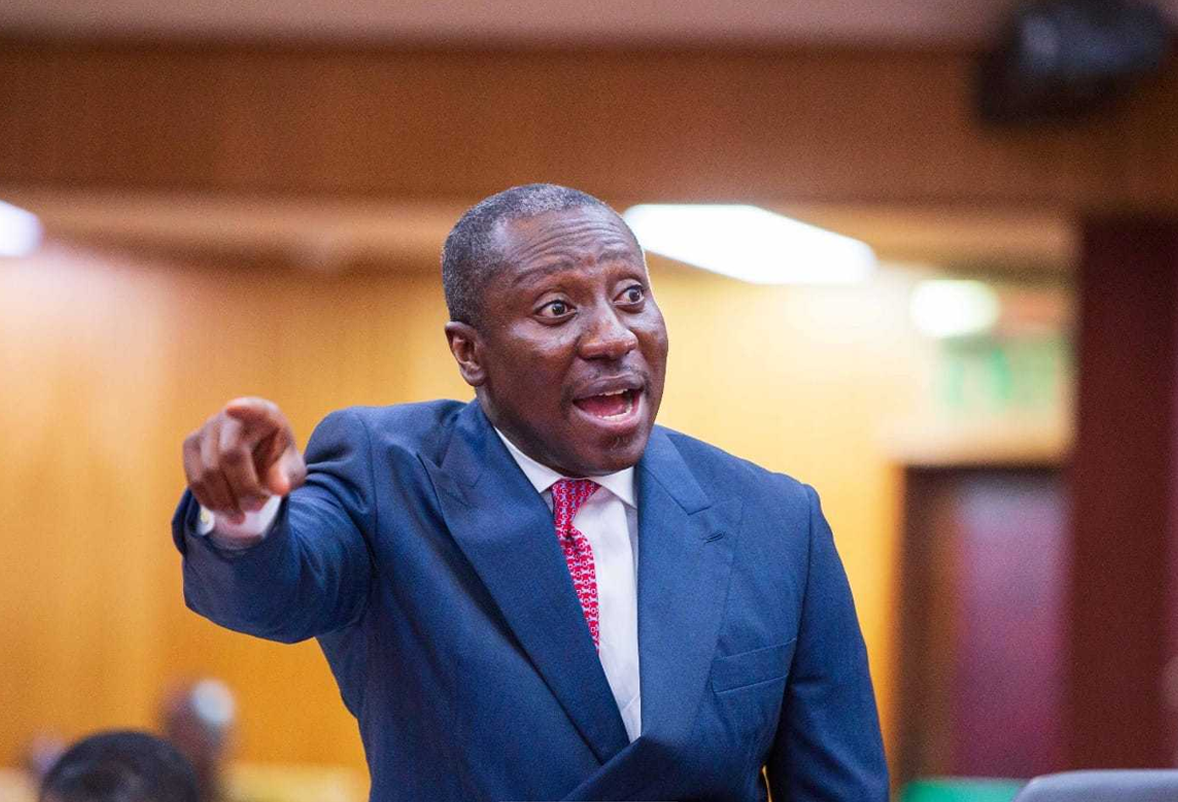
The Minority in Parliament has criticised the 2027 Budget, arguing that the government’s claims of economic stability have yet to translate into lower food prices, increased employment opportunities or meaningful relief for businesses.

Addressing journalists on Thursday following the presentation of the budget by Finance Minister Dr Cassiel Ato Forson, Minority Leader Alexander Afenyo-Markin accused the government of relying on political slogans rather than providing practical solutions to the economic difficulties facing Ghanaians.
“Stability on paper, hardship in our pockets,” he declared.
Mr Afenyo-Markin maintained that the cost of food remained high in markets across the country, citing Techiman, Tamale, Kumasi Asafo, Winneba Central and Makola as examples of markets where consumers continued to struggle with rising prices.
He argued that farmers were not receiving adequate support and questioned why locally produced staple foods remained expensive despite the government’s assurances about economic recovery.
The Minority Leader also criticised the government’s handling of the cocoa sector, arguing that the farmgate price offered to cocoa farmers had declined despite promises made by the NDC while in opposition.
He rejected the Finance Minister’s appeal for patience, insisting that after two years in government, Ghanaians expected tangible improvements in employment and their general living conditions.
“The NDC cannot rebrand unemployment. They cannot slogan away the cost of living,” he stated.
Mr Afenyo-Markin further questioned the relationship between the government’s proposed New Economy Programme and its flagship 24-hour economy policy, demanding greater clarity on how the two initiatives would complement each other.
He also raised concerns about the proposed 2027–2030 development timeline, arguing that the government had not provided sufficient details about the financing and implementation of its US$10 billion New Economy initiative.
In particular, he questioned how much of the proposed funding would be committed in 2027 and demanded that specific projects be identified to allow Parliament to monitor expenditure and assess implementation.
“They also failed to tell us how much will be expended in 2027 and the specific projects this will finance for proper tracking,” he said.
Although he welcomed the government’s indication that it could meet its obligations under the Domestic Debt Exchange Programme (DDEP), the Minority Leader questioned why similar financial commitments were not being made towards public sector workers and recruitment.
He specifically cited outstanding financial obligations to members of the Judicial Service Staff Association of Ghana (JUSAG), teachers and nurses, while questioning the government’s capacity to recruit additional workers.
“But the question is that where is the money to pay JUSAG, the money to pay teachers, the money to pay nurses, and the money to recruit?” he asked.
He also accused the government of failing to provide clear figures on the number of jobs created since assuming office, insisting that employment outcomes should be the primary measure of economic recovery.
“It is not data that Ghanaians are going to consume. Ghanaians want jobs, jobs, jobs,” he stressed.
On gender-focused economic interventions, Mr Afenyo-Markin questioned the status of the proposed women’s bank, arguing that the initiative had featured in previous budget statements but was conspicuously absent from the latest presentation.
He also expressed concern about the business environment, warning that high electricity costs and inadequate incentives for investors could undermine private sector growth.
Comparing the proposed exemptions on machinery with incentives introduced under the previous New Patriotic Party (NPP) administration, he argued that the government needed to do more to encourage businesses to expand and invest.
“Without the private sector, the economy cannot grow,” he said.
The Minority Leader indicated that the caucus would undertake a more detailed examination of the 2027 Budget and present a comprehensive assessment following its parliamentary budget workshop.


