


By Juliet Akosua Danquah

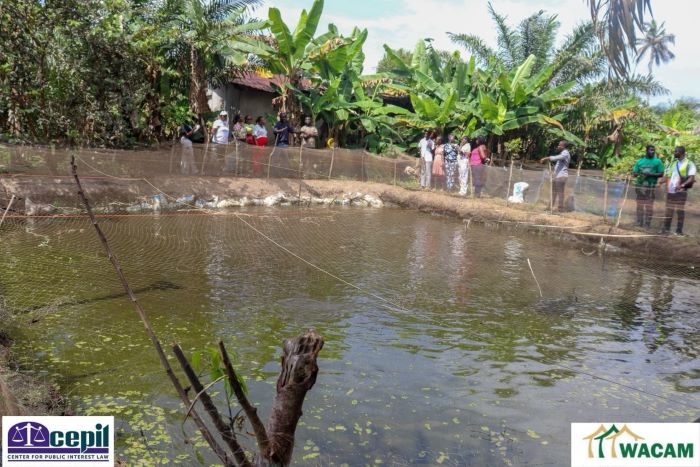
Wacam, in collaboration with the Centre for Public Interest Law (CEPIL) and Friends of the Nation (FON), has organised an exchange visit for women from communities affected by the proposed Ewoyaa Lithium Project to Ellembelle, to learn from women-centred corporate social responsibility (CSR) initiatives of Ghana Gas Company Limited (GGCL) and ENI.
The visit, held under the Transformative Women Human Rights Defenders in Extractives Communities in Ghana-OCI Seed Fund by Oxfam, formed part of efforts to strengthen women’s knowledge and capacity to engage companies and other stakeholders on their rights and development priorities.
The key objective of the exchange visit was to facilitate peer learning and experience-sharing between women from communities affected by the proposed Ewoyaa Lithium Project and established institutions and communities with experience in natural resource operations and community engagement.
It also sought to expose participants to community development interventions and to strengthen their capacity to engage on resettlement, compensation, livelihood restoration and community participation.
 The Ellembelle visit took place on Monday, 13 October, 2026, as part of a broader exchange visit from 12 to 15 October, 2026, which also covered Tarkwa.
In all, 60 participants – 39 women and 21 men – took part, drawn from Krofu, Krampakrom, Afrangua, Anokyi, Ansaadze, Abonko and Ewoyaa, communities within the Ewoyaa lithium project landscape in the Mfantseman Municipality, Central Region.
In Ellembelle, participants engaged representatives of GGCL and ENI to understand their women-centred CSR initiatives, particularly interventions in education, health and socio-economic empowerment.
Officials of the two companies shared practical examples of their community interventions, including support for girls’ education through the renovation of the Half Assini SHS girls’ dormitory and assistance to Axim Girls SHS.
Participants were taken through how the interventions were designed, how they benefit girls and women, and how they contribute to community development.
 For the women from Ewoyaa, the engagements provided an opportunity to learn about community development initiatives and approaches to supporting women’s livelihoods, and to compare them with what they expect from companies operating in their own area.
Participants said the engagements demonstrated how corporate social responsibility interventions in education, health and women’s socio-economic empowerment can contribute to community development.
The visit highlighted that such initiatives provide useful lessons for strengthening discussions on corporate responsibility in the Ewoyaa project landscape.
 It also reinforced the importance of organising women and strengthening community representation to ensure that their concerns are heard and addressed in engagements with companies and relevant authorities.
According to the organisers, when women are informed, they are better placed to participate in discussions on land acquisition, compensation, resettlement and livelihood restoration which are decisions that directly affect their socio-economic well-being.


