


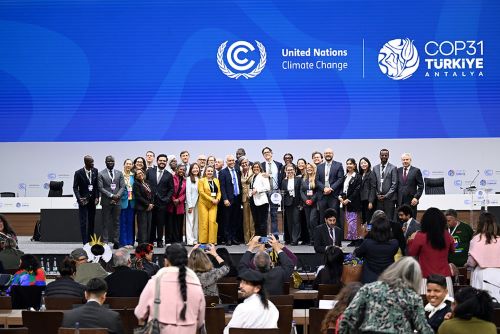
The COP31 Presidency has put the ocean and nature at the centre of the climate agenda, with new efforts to protect shared seas and coastlines, expand blue finance and strengthen links between climate, biodiversity and land.

COP31 President, Murat Kurum, said the ocean regulated the climate, supported livelihoods and sustained communities around the world, but warming, acidification, sea-level rise and pollution were putting marine ecosystems and coastal communities under growing pressure.
“We know many of the solutions, from restoring coastal ecosystems and strengthening early-warning systems to improving ocean science and data-sharing and building greater resilience in the communities most exposed,” he said.”
Too often, the challenge was connecting those solutions with the expertise, partnerships and existing sources of finance needed to put them into practice. COP31 is bringing countries and partners together to strengthen cooperation across shared seas and coastlines, including through the Antalya Ocean and Seas Compact.”
COP31 Pacific Envoy for the Ocean, the Honourable Inia Seruiratu, said for Pacific nations, the ocean is economy, food security, and a way of life. “It sustains billions of people and is a vital regulator of the global climate. The Ocean is central to the climate solution – climate action cannot succeed without it,” he said.
Turning ambition into action
The Presidency unveiled the Antalya Ocean and Seas Compact, which aims to strengthen partnerships and improve access to finance. The Compact encourages countries to enhance ocean-related policies to cut emissions and improve adaptation and resilience in their national climate plans. It also highlights the limited share of climate finance that reaches ocean-related priorities and invites institutions and partners to facilitate access to blue finance, including through initiatives such as the COP31 Climate Implementation Bridge.
The Compact will sit alongside practical initiatives including the Regional and International Cooperation for Ocean & Seas Initiative, which brings countries and partners together to better protect shared seas and coastlines.
The initiative will strengthen regional cooperation, improve access to ocean data and early-warning systems, restore marine ecosystems and help turn coastal priorities into projects that can attract investment. By 2035, it aims to restore at least 20% of degraded priority coastlines, support cleaner maritime energy and greener ports, increase climate-ready investment in shipping and tourism, and expand early-warning systems for vulnerable coastal communities.
The Presidency also brought the Marine Litter Action Platform to a wider international audience at COP31, building on its launch at the Trabzon Oceans and Seas Summit in September. Leveraging Türkiye’s Zero Waste experience, the Platform will help scale proven solutions to marine pollution by connecting countries and projects with expertise, knowledge and finance.
Ocean finance and science
Türkiye and Australia are working together to unlock more finance for ocean and coastal projects, particularly in Small Island Developing States. The two countries also brought scientists and decision-makers together to highlight Antarctica’s role in the global climate system and what Antarctic science can tell us about changes affecting oceans and communities around the world.
Tackling climate, biodiversity and land together
Climate change, biodiversity loss and land degradation are closely connected, but efforts to tackle them are too often pursued separately. The COP31 Presidency established the Rio Synergies Group for Action, a voluntary, country-led initiative to help countries better coordinate existing priorities across climate, biodiversity and land and connect them with expertise, partnerships and finance. The Group builds on cooperation across the three Rio Conventions and is designed to support implementation without creating new commitments or reporting requirements.
COP31’s focus on international cooperation also extends to green industrialisation and the circular economy. During the conference, Türkiye and Germany have highlighted their cooperation through Germany’s International Climate Initiative (IKI), including work on carbon pricing. Türkiye and IKI launched an IKI Large Grant Call on Energy and Circularity Transformation in the Building Sector, contributing to COP31’s thematic priority on more efficient and sustainable cities.
The Director General of Environmental Management at Türkiye’s Ministry of Environment, Urbanisation and Climate Change, Fatih Turan, said the Antalya Ocean and Seas Compact translates shared commitment into a concrete plan of action. “It strongly reaffirms the central role of oceans and seas in combating climate change. In the Mediterranean basin – one of the world’s foremost climate change hotspots — we recognize that tackling threats such as warming, marine pollution, and coastal erosion is only possible through solidarity that transcends borders,” he said.
The UN Secretary-General’s Special Envoy for the Ocean, Peter Thomson, said the Antalya Ocean Compact faithfully delivers on the promise the COP31 Presidency made at the Pacific Pre-COP in Fiji.
“Just as no serious consideration of climate change is complete without the ocean, none is complete without recognizing the central importance of transitioning away from burning fossil fuels,” he said.


