


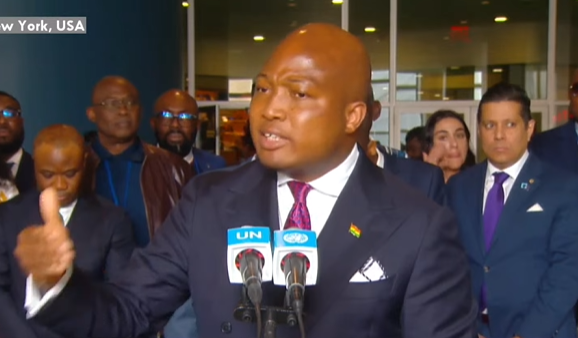
Ghana has strongly criticised the United States following its decision to vote against a landmark resolution at the United Nations General Assembly recognising the Trans-Atlantic Slave Trade as the “gravest crime against humanity.”

The resolution, spearheaded by Ghana, was adopted with overwhelming support, securing 123 votes in favour. However, the United States joined Argentina and Israel in opposing the motion, while 52 countries—largely from Western Europe—abstained.
Speaking on the BBC’s Focus on Africa on Friday, March 27, Ghana’s Minister for Foreign Affairs and Regional Integration, Samuel Okudzeto Ablakwa, described the U.S. position as disappointing and a missed opportunity for global reconciliation.
“The USA voting against it is most disappointing because they know their role in this,” he said, adding that the vote reflected a reluctance to fully acknowledge historical responsibility and engage in reparatory justice.
The U.S. government, under the Trump administration, defended its stance, describing the resolution as “highly problematic.” While acknowledging the injustice of slavery, American officials raised concerns about the intended beneficiaries and the legal implications of financial reparations.
Despite the opposition, the resolution marks a significant shift in global discourse. Beyond symbolic recognition, it calls for structured dialogue and concrete measures to address the lasting socio-economic and cultural impacts of the slave trade on African countries and the global diaspora.
Mr Ablakwa emphasised that the door remains open for the United States to reconsider its position and join the growing international coalition supporting the initiative.
“Ghana’s message… is that you missed a golden opportunity, but it is not too late,” he said, urging Washington to support efforts aimed at dismantling systemic racism linked to the legacy of slavery.
The voting pattern highlights a widening divide in global perspectives. Support largely came from African, Caribbean and Latin American countries, along with parts of Asia and Eastern Europe, while opposition was limited to three countries and abstentions were dominated by Western European nations.
As Ghana leads efforts through the African Union’s reparations agenda, attention is now focused on how the resolution will be implemented and whether major global powers will engage in building a framework for reparatory justice.
For Ghana, the push goes beyond historical acknowledgement, aiming to establish a concrete global system to address the enduring consequences of centuries of human exploitation.


