


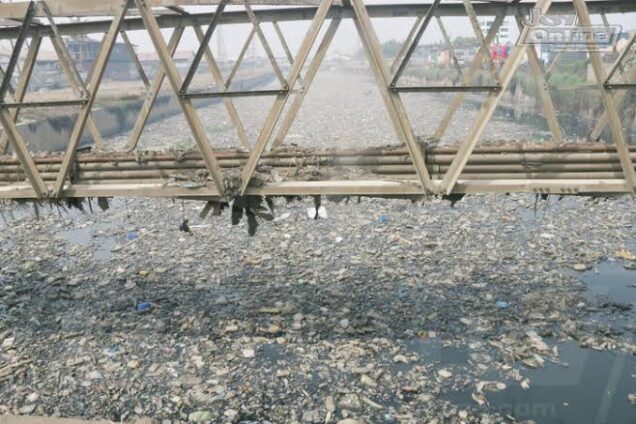
The Greater Accra Resilient and Integrated Development (GARID) Project has disclosed that dredging of the Odaw Channel—one of Accra’s most critical flood-control interventions—is only about 40% complete, despite the capital experiencing one of its worst flooding incidents in recent years.

Speaking on Joy FM’s Super Morning Show, GARID Project Coordinator, Dr. Ohene Sarfoh, said dredging works along the channel, which stretches from Cape Coast Road to the Korle Lagoon, are progressing steadily and are expected to be completed before the end of the year.
“The contractor has completed about 40 per cent of the dredging, and we expect the entire exercise to be finished before the end of the year,” he said.
Dr. Sarfoh explained that once the initial dredging phase is completed, the contractor will continue with routine maintenance dredging over the remaining three years of the contract to remove sediment that naturally accumulates in the channel.
Responding to questions on whether the World Bank-funded project had achieved its flood mitigation objectives, he admitted that the programme has yet to fully meet its targets.
“No, we haven’t fully achieved that, but we are on our way. There are exacerbating circumstances that are also impeding our ability to fully attain those objectives,” he stated.
The GARID Project, launched in 2020 as a five-year initiative to improve flood risk management and solid waste management within the Odaw River Basin, has since been extended to December 31, 2027, following implementation delays and additional financing.
According to the latest World Bank implementation review, the project has disbursed US$127.1 million of its US$350 million financing package, representing 36.3% of the total available funding.
Dr. Sarfoh attributed delays in the dredging works to operational challenges, including the temporary suspension of activities to clear accumulated dredged material from riverbanks and difficulties in securing temporary disposal sites. He noted that the dredging contract, which began in February 2024, is structured as a four-year performance-based agreement, with the first year dedicated to major dredging and the remaining three years focused on maintenance.
Beyond the Odaw Channel, he said significant progress has been made on other drainage infrastructure projects across the capital.
According to him, drainage works have been completed from Accra Academy to South Kaneshie, connecting with an earlier completed section extending from Abeka Junction through Odo Road to the South Industrial Area.
He added that construction on the next phase—from Abeka Junction to Pampaso—is expected to commence soon but will require extensive traffic management because the westbound carriageway will be temporarily closed during construction.
“We need to be careful about how we commence works and divert traffic,” Dr. Sarfoh said, noting that consultations with relevant stakeholders are ongoing before work begins.
He further revealed that drainage works are progressing along the eastern section of the Odaw Basin, from the vicinity of the Bank of Ghana through South Kaneshie towards Apenkwa, although similar traffic management challenges are anticipated.
His comments come in the wake of torrential rains that submerged large sections of Accra, disrupting transportation, businesses and public services.
Addressing the nation on Monday, President John Dramani Mahama disclosed that preliminary data indicated approximately 140 millimetres of rainfall fell over Accra during the storm—more than double the highest daily rainfall recorded in 2025.
The President attributed the flooding to exceptionally heavy rainfall, the effects of climate change, inadequate drainage infrastructure, rapid urbanisation, encroachment on waterways and indiscriminate waste disposal.
GARID is Ghana’s first World Bank-funded urban resilience programme. In addition to flood-control interventions, the project supports solid waste management, community upgrading initiatives and institutional capacity building across 17 Metropolitan, Municipal and District Assemblies within the Odaw River Basin.
Flood mitigation projects are also ongoing in several flood-prone communities, including Kaneshie, Paloma-Asylum Down, Achimota, Nima, Akweteyman and Alogboshie, as authorities seek to strengthen Accra’s resilience against increasingly frequent flooding.


