


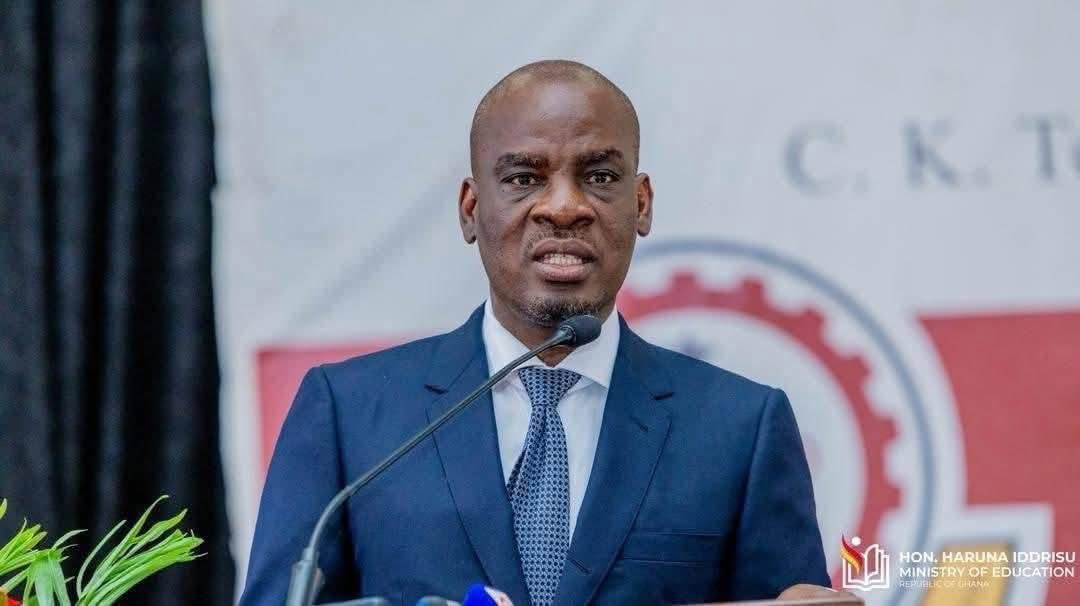
Education Minister Haruna Iddrisu has acknowledged challenges with the 2026 Senior High School (SHS) placement exercise but says the widely cited figure of about 55,000 affected candidates does not represent students who have simply been left without school placements.

Speaking on JoyNews’ Newsfile on Saturday, Mr Iddrisu said government recognised problems with the Computerised School Selection and Placement System (CSSPS) and was focused on addressing the underlying issues rather than merely dealing with their effects.
“I admit that we have a problem as a country. I am not interested in dealing with the symptoms; I want to deal with the real problems,” he said.
According to the Minister, about 604,000 students are currently in the placement system, with 527,000, representing 87 per cent, already placed.
He said the figures should be viewed in context, particularly as vacancies remain available in a number of schools.
Mr Iddrisu, however, acknowledged that available vacancies do not necessarily address the concerns of affected families, especially where the remaining spaces are in schools that were not among students’ preferred choices.
Pressure on Category A schools
The Minister identified the high demand for a relatively small number of Category A schools as one of the major challenges confronting the placement system.
He said between 313,000 and 328,000 applications had been made for Category A schools, which collectively have about 76,000 vacancies.
According to him, the figures highlight the pressure created when a large number of students compete for limited spaces in highly sought-after schools.
Mr Iddrisu said government was therefore seeking to address structural weaknesses in the CSSPS rather than relying solely on temporary measures to resolve individual placement difficulties.
New approach to school selection
The Education Minister also defended a change introduced this year requiring students to wait for their examination results before making their final school choices.
He said the policy was intended to enable students and parents to make more informed decisions based on actual academic performance.
Under the new arrangement, candidates are expected to consider their results and competitiveness before selecting schools, while the placement system takes into account available vacancies and other placement considerations.
Mr Iddrisu said the approach was designed to reduce unrealistic expectations and the mismatch between students’ preferred schools and the number of available places.
What the 55,000 figure represents
The Minister’s comments come amid public concern over reports involving approximately 55,000 candidates in the 2026 placement exercise.
The figure, however, has generated some confusion.
The CSSPS Secretariat previously indicated that about 565,000 of nearly 620,000 candidates who sat the 2026 Basic Education Certificate Examination (BECE) had qualified for placement, while approximately 55,000 did not initially qualify after failing either English Language or Mathematics.
The Ministry has since clarified that candidates who obtained Grade 9 in either English Language or Mathematics are eligible to use the self-placement process to select schools with available vacancies.
Mr Iddrisu’s comments therefore highlight an important distinction between candidates who have not secured their preferred schools and those who did not initially qualify for placement under the stated criteria.
He said government’s priority was to address the structural challenges within the placement system and make the process more responsive to the needs of students and their families.


