


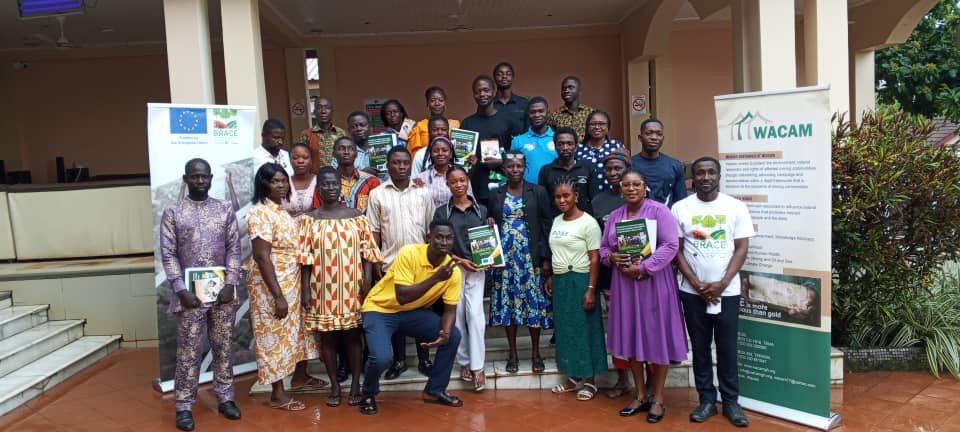
About thirty trained paralegals from mining-affected communities in Ghana’s Western and Western North Regions have been tasked with the critical responsibility of ensuring that human rights violations in their communities are addressed.

The participants were drawn from BRACE affected communities including Awaso and Paboase in the Western North Region, and Bonyere, Tarkwa, Breman-Brofoyeduro and Bogoso in the Western Region.
Addressing the paralegals at the end of a three-day training (from October 14-18, 2025) organised by Wacam in collaboration with A Rocha Ghana and Nature and Development Foundation (NDF), the Executive Director of Centre for Public Interest Law (CEPIL), Lawyer Augustine Niber, urged them to be proactive but also cautious in the line of duty as paralegals.

He encouraged them to come together and work as paralegals, adding that distance should not be a barrier from preventing them from collaborating.
Later in a presentation, the Executive Director of CEPIL took the participants through the work of a paralegal. He explained that a paralegal is a person who is educated, trained, and equipped with basic knowledge and skills in the law to provide legal and other assistance to communities.
“Paralegals work in and with communities, and also organise communities to struggle for their rights,” he said.
Lawyer Niber noted that the duties and responsibilities of a paralegal include providing legal advice, conducting public education on the law and basic rights, monitoring human rights, networking, dispute resolution, and advocacy, among others.
“A paralegal must possess the basic skill in public relations and produce easy to read human rights booklets,” he stressed.
Furthermore, he educated them on compensation and resettlement principles and access to justice and why human rights monitoring was crucial in their line of work as paralegals.
The Associate Executive Director of Wacam, Mrs. Hannah Owusu-Koranteng, took the participants through topics including; Mining and Development and Alternative Dispute Resolution (ADR).
She said understanding the causes, types and phases of conflict was vital for effective resolution and management.

“It helps in identifying appropriate strategies for negotiation, mediation, or resolution,” she noted.
She indicated that there are mainly three ADR methods of resolving disputes which are negotiation, mediation and arbitration.
A Senior Lecturer at the University of Cape Coast (UCC), Dr. Edgar Takyi Akonor, who spoke on the topic: ‘Gender and Extractive Governance’ indicated that the importance of ensuring that women have same equal access to the benefits of Extractive Industry (EI) is that it is a human right issue “because women have the same right to development as men.”
He lamented that oftentimes women were not consulted when companies negotiate access to land, compensation or benefits when mining damages the environment.

“Compensation and benefits are paid to men on behalf of their families, denying women access to mining’s financial benefits and potentially increasing their economic dependence on men,” he said.
To this end, Dr. Akonor recommended the integration of gender inclusion programmes, noting that this should include awareness campaigns, strengthening of community oversight of mining projects, creating a community fund for women’s resources, and enforcement of human rights.
Speaking on ‘Environmental and Human Right Issues Associated with Mining in Ahafo Region,’ the Executive Director of Centre for Environmental Impact Analysis (CEIA), Dr. Samuel Obiri, said studies have shown that various chemicals used in mining have had effects on reproductive health
These chemicals, he pointed out, included lead, cadmium, arsenic, zinc, manganese and mercury have been shown to affect the reproductive function of human reproductive

“Lead harms both male and female reproductive health; cadmium is also a risk factor for poor pregnancy outcomes,” he stated.
Lawyer Kwaku Afari, who took the participants through Free Prior and Informed Consent (FPIC) stressed that this principle required that communities give their consent before any activity likely to affect them is accrued out.
“The FPIC principle is an empowering tool, which grants communities the authority to define their own goals and destiny and to have a meaningful say in development,” he indicated


