


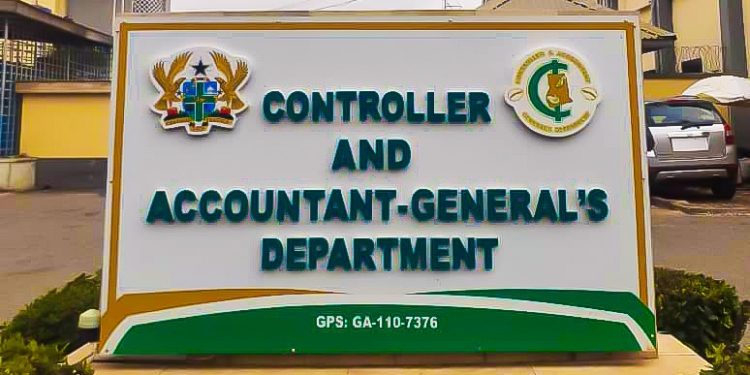
A member of the Review Committee of the Civil and Local Government Staff Association of Ghana (CLOGSAG), Daniel Appiah, has questioned the justification for proposals to make the Controller and Accountant-General’s Department (CAGD) independent of the Ministry of Finance.

Speaking in an interview on Joy FM’s Top Story on Wednesday, March 4, Mr Appiah described the recommendation by the Constitutional Review Committee (CRC) as “problematic and challenging,” despite acknowledging that the committee had made several useful proposals.
His comments follow CLOGSAG’s rejection of the CRC’s recommendation to convert the CAGD into an independent or hybrid constitutional office.
The association argues that the department, which currently operates as an implementing agency under the Ministry of Finance, should remain under the ministry’s administrative oversight to ensure proper fiscal coordination.
Addressing a press conference in Accra on March 4, CLOGSAG’s Executive Secretary, Isaac Bampoe Addo, warned that the proposed change could create institutional confusion and weaken the country’s financial management framework.
“We disagree with the proposals to establish the Controller and Accountant-General as an independent or hybrid independent constitutional office. The mandate of the Controller and Accountant-General’s Department falls squarely within the functional oversight responsibilities of the Ministry of Finance,” Mr Addo stated.
Expanding on the association’s concerns, Mr Appiah said the 1992 Constitution of Ghana already outlines clear procedures for appointing heads of public service institutions.
“If you look at the 1992 Constitution, it makes provisions for how heads of public service organisations should be recruited. The President makes the appointment acting on the advice of the governing council of that particular service,” he explained.
He cited the Audit Service of Ghana as an example, noting that the Auditor-General is appointed based on the advice of its governing board, demonstrating existing constitutional safeguards.
Mr Appiah also criticised the CRC for failing to clearly identify the problem the recommendation seeks to resolve.
“The Constitutional Review Committee has not stated any problem for which they have come out with recommendations concerning the Controller and Accountant-General’s Department. In the absence of any clearly defined problem, one cannot logically accept the solutions that they have proposed,” he argued.
While acknowledging that several of the CRC’s broader recommendations could help Ghana move from what he described as “an electoral democracy to a development-focused nation,” he maintained that any institutional reforms must be based on clearly identified gaps within the existing system.


