


COP31 on Friday, November 13, 2026, brought governments, financial institutions and businesses together to tackle one of the biggest barriers to climate implementation – getting finance to the projects and countries that need it.

Together with the COP31 Business Forum, the Finance and Trade Day focused on turning existing promises and resources into substantive projects and investments, as well as mobilising additional finance for priority areas.
More countries join BRIDGE
Chile, Lebanon, Mexico and Zambia have joined the COP31 Presidency’s Climate Implementation Bridge (BRIDGE) platform, designed to help countries move from climate commitments to delivery. They follow Ethiopia, Fiji, Indonesia, Pakistan and Uzbekistan, the first BRIDGE cohort, announced during the 81st United Nations General Assembly High-Level Week in New York.
Together, these countries represent diverse climate and development contexts and a growing portfolio of investment opportunities across mitigation, adaptation and resilience. BRIDGE leverages the United Nations’ “Climate Promise: Forward”, which provides a common framework to accelerate implementation and help governments turn national climate priorities into investable project pipelines. It does this by identifying bottlenecks, strengthening institutional capacity, and connecting countries with technical, financial and delivery partners.
On Friday, Türkiye’s Ministry of Treasury and Finance together with the Ministry of Environment, Urbanisation and Climate Change and the UN Development Programme (UNDP) signed a Memorandum of Understanding to support this work, with Türkiye committing USD $3M in grants for the operationalisation of the platform. The five initial BRIDGE countries are undertaking country-led diagnostic assessments to identify priority sectors, investment needs and implementation barriers.
The findings will inform tailored support and help countries develop investment-ready projects. A growing coalition of implementation partners has also pledged support for the COP31 Presidency’s implementation agenda. In a joint statement presenting the Multilateral Development Bank (MDB) Partnership for Adaptation and Resilience Investment, institutions including the Asian Development Bank and the European Bank for Reconstruction and Development agreed to expand MDB investment in response to strong client demand and mobilise more public and private finance for adaptation.
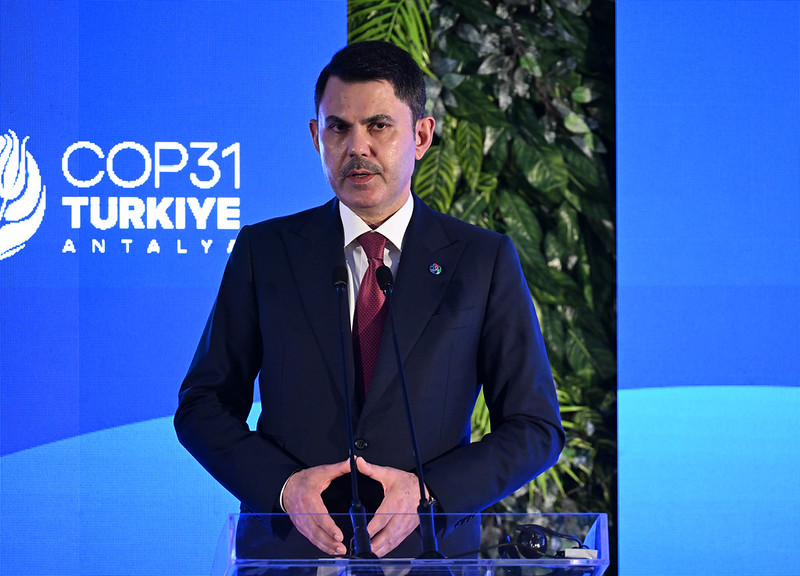
COP31 President, Murat Kurum, said: “The critical gap we must close is between climate ambition and implementation. Through BRIDGE, we help countries turn their national priorities into investable projects and connect them with the finance, capacity and partnerships needed to deliver. At COP31, we are calling on governments, financial institutions and businesses to help move climate action from plans on paper to results on the ground.
“Private sector takes centre stage
Across the two-day COP31 Business Forum, organised by the Union of Chambers and Commodity Exchanges of Türkiye (TOBB), governments, business leaders, investors and financial institutions explored how finance and technology can accelerate climate implementation. COP31 was launched with a vision to advance implementation and foster a constructive platform for dialogue aimed at addressing challenges and identifying solutions. Guided by this vision, the COP31 Presidency is ensuring that all voices are heard and that all stakeholders have the opportunity to contribute meaningfully to the development of solutions.
The COP31 Business Forum is bringing the private sector into that effort, with businesses, investors and experts developing practical recommendations grounded in the realities of investment and delivery. This was the largest ever gathering of businesses at a COP with 4,000 attendees and 100 speakers across 23 sessions. Yesterday, TOBB released a synthesis of recommendations covering finance, standards and market rules, demand creation, institutions and implementation tools.
Tackling barriers to climate finance
COP31 is also advancing efforts to improve access to climate finance. The Coalition of Finance Ministers for Climate Action heard from the UN Secretary-General, Türkiye and Australia on the need for enhanced coordination and cooperation between climate ministries and finance ministries to implement the Paris Agreement. Australia’s green bank, the Clean Energy Finance Corporation (CEFC), in conjunction with Natural Resources Defense Council (NRDC) and SOAS University of London, launched the Green Bank Accelerator which will provide support to developing countries to develop their green banking capability and access finance.
In just over a decade of operation, the CEFC has mobilised over $100 billion AUD towards Australia’s net zero transition. COP31 President of Negotiations and Australian Minister for Climate Change and Energy Chris Bowen said: “Climate finance only works if communities can access it. Pacific countries have been clear about the barriers they face. Only 0.2% of the world’s climate finance is going to small island developing states for adaptation.
“Finance is also a barrier for the next generation of farmers. Improving access to finance and capital in agriculture will be crucial for farmers to strengthen food security, climate resilience and rural communities. The Back Future Farmers Launch at COP31 brought together young people, policymakers, funders and industry leaders to help turn agricultural ideas into successful careers and commercially viable businesses.
The focus on practical financing solutions builds on previous developments at COP31 when international financial institutions, city networks, UN entities and MDBs including the World Bank, Asian Infrastructure Investment Bank, Asian Development Bank and European Bank for Reconstruction and Development confirmed their support for one of the Presidency’s priority initiatives, the Sustainable Urban Resilience Financing Facility (SURFF).
Rather than creating a new fund, SURFF is a coordination and implementation mechanism that will help countries and cities turn urban resilience priorities into investment-ready projects and connect them with existing finance, technical expertise and implementation support.
Finance and Trade Day also strengthened cooperation with the Network for Greening the Financial System (NGFS) on the economic and financial risks of climate change and the low-carbon transition. Building on the declaration issued in the lead up to COP31’s opening by the NGFS, a high-level event hosted by Central Bank of the Republic of Türkiye Governor, Fatih Karahan, with NGFS Chair, Olaf Sleijpen, highlighted the role of cooperation and knowledge-sharing in supporting more coherent and effective policy responses.
What they said
UN Climate Change Executive, Secretary, Simon Stiell, said: “Many developing countries are trapped in a downward loop of debt, climate disasters, and devastating capital costs. The threat of floods, fires, storms and droughts hangs over them – pushing up the price of borrowing even before disaster strikes. To tackle the problem, the world has agreed ambitious climate finance goals. Now, it’s time to deliver. To make the climate finance system simpler, and fairer – improving access. Vulnerable developing countries need more affordable finance, faster. Investment is growing, but it must reach more countries and benefit more people in more places. The UN climate process is a huge part of making that happen.
“The Administrator of the UN Development Programme, Alexander De Croo said: “Countries have climate plans. Investors have capital. BRIDGE will help connect the two by turning national priorities into investments that a variety of public and private partners can fund. Led by Türkiye’s COP31 Presidency and with participating countries, it brings together country leadership, finance and delivery.
UNDP contributes its sustainable finance expertise and local presence on the ground in 170 countries to help make it work. Success will be measured in safer communities, reliable clean energy and sustainable growth. A bridge is only worth building if people cross it. This one must carry investment into countries and deliver results for people.”
The President of the Union of Chambers and Commodity Exchanges of Türkiye (TOBB), Rifat Hisarcıklıoğlu said: “The COP31 Business Forum is the largest business gathering at a COP and brings together senior representatives from the global business community, international organisations, development banks, and the public sector. We are addressing issues that are critical to our shared future, including financing climate investments, global energy security, accelerating electrification across sectors from transportation to industry, sustainable agriculture and strengthening the resilience of cities to climate change.”
İLBANK General Director, Eyyüp Karahan said: “Our ambition is to develop a model that begins in Türkiye and can be replicated across other countries over time, contributing to stronger climate resilience in cities around the world. At İLBANK, we are bringing together our decades of experience in municipal financing and infrastructure investment with the financial resources and technical expertise of our international partners. With SURFF, we are establishing an international cooperation mechanism designed to enable precisely this transformation.”The President of the Asian Development Bank (ADB), Masato Kanda said: “The Asian Development Bank (ADB) welcomes the COP31 Presidency’s focus on implementation.
As multilateral development banks, country priorities drive our work. We are committed to moving faster and working together to finance the outcomes that matter most. This means greater resilience, faster low-carbon growth, more jobs, and improved lives.”
The President of the European Bank for Reconstruction and Development (EBRD), Odile Renaud-Basso said: “The green transition is one of the greatest economic opportunities of our time. It can help build more resilient, efficient and competitive economies.
We must seize this opportunity and accelerate the pace of implementation. As MDBs, we are committed to working together, and with our partners, to deliver climate action at the scale and speed required.”COP31 is the 31st Conference of the Parties to the UN Framework Convention on Climate Change and takes place in Antalya, Türkiye, from 9–20 November 2026.


