


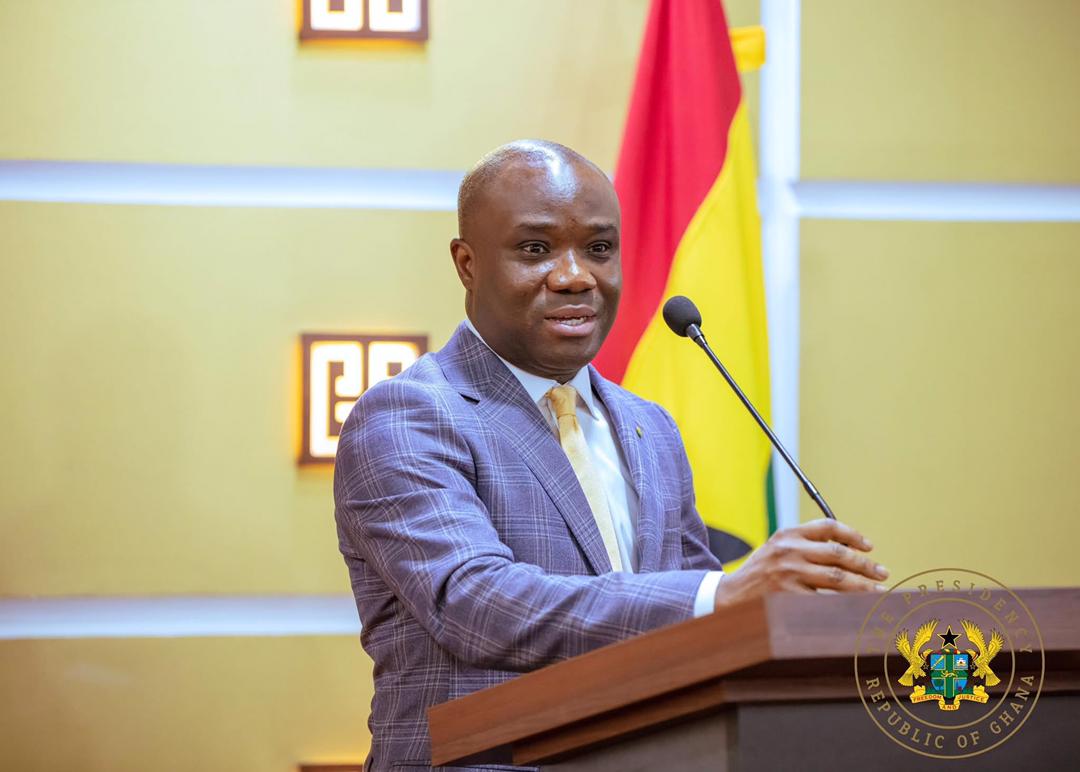
Government spokesperson Felix Kwakye Ofosu has urged journalists and media organisations to uphold professional standards and resist the temptation to prioritise sensational headlines over credibility.

Speaking at an event organised at the residence of the British High Commission Ghana to commemorate World Press Freedom Day, the Abura-Asebu-Kwamankese MP warned that misinformation and disinformation pose growing threats to democracy, public trust, and national stability.
“Public trust is your greatest capital. Do not spend it for a headline,” he told journalists and media stakeholders gathered at the event.
Mr Kwakye Ofosu described a free and independent press as essential to democratic governance, stressing that governments should not view critical journalism as hostility.
“A government that fears questions has already lost its confidence, and a society that silences journalists has already begun to lose its democracy,” he said.
According to him, responsible journalism strengthens governance and accountability rather than undermining it.
“When a reporter investigates a contract gone wrong, they are not attacking the state. They are protecting the taxpayer,” he added.
The government spokesperson also reaffirmed the government’s commitment to safeguarding press freedom, media pluralism, and the safety of journalists across the country.
“On behalf of the Government of Ghana, I reaffirm our commitment to protect the safety of journalists, to uphold media pluralism and to ensure that no reporter is harassed, detained or threatened for doing lawful work,” he stated.
A major focus of his address, however, centred on the rapid spread of false information in the digital age.
“We now live in an age where a single falsehood can travel around the world in seconds while the truth is still putting on its shoes,” he said.
Mr Kwakye Ofosu warned about the dangers of coordinated disinformation campaigns, deepfakes, and clickbait content designed to inflame political and ethnic tensions or exploit public attention for profit.
“This is not just a media problem. It is a national security problem. It is a public health problem as it is a democratic problem,” he stressed.
Despite the concerns, he argued that censorship was not the solution to misinformation, insisting instead on the need for timely, accurate, and credible information.
“We must answer bad information with better information and faster,” he said, revealing that the government communications office had intensified efforts to proactively provide accurate public information.
He further noted that media freedom must be matched with responsibility and ethical conduct.
“Free means that you are independent of political and commercial pressure. Responsible means adhering to ethics, accuracy, fairness, right of reply and respect for privacy and human dignity,” he explained.
Mr Kwakye Ofosu also called on the Ghana Journalists Association and the National Media Commission to strengthen self-regulation mechanisms and enforce professional standards within the media space.
“Publishing unverified allegations, amplifying hate speech for engagement, that is not dramatic, that is harm,” he cautioned.
He additionally urged public institutions to improve transparency and responsiveness under Ghana’s Right to Information framework, insisting that citizens deserve truthful and accessible information.
“The Ghanaian public deserves Straight Talk,” he said.
Concluding his remarks, the government spokesperson underscored the importance of journalism in sustaining democratic governance.
“Democracy is not a gift that lasts forever. It is a practice that must be renewed every day, and journalism is one of the daily practices that keeps it alive.”


