


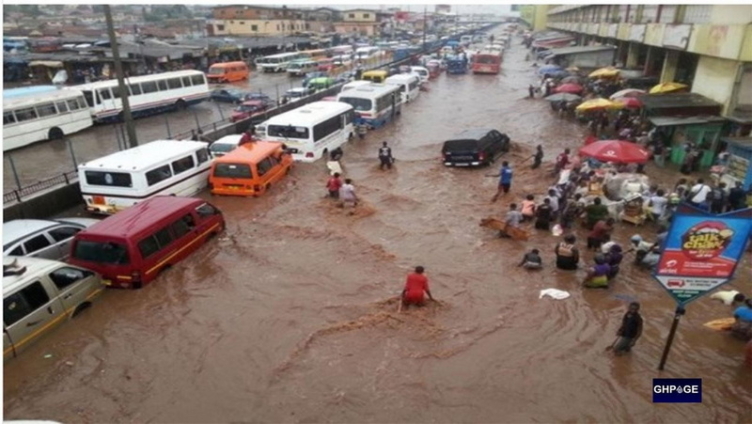
President of the Ghana Institution of Engineers (GhIE), Ing. Ludwig Annang Hesse, has attributed Accra’s recurring flooding challenges to decades of poor infrastructure planning and unchecked urban development.

Speaking on Joy FM’s Super Morning Show, Ing. Hesse argued that the capital’s infrastructure development trajectory over the past 30 to 40 years has fundamentally undermined the city’s natural flood management systems, making it increasingly vulnerable to severe flooding.
According to him, extensive development on water-retention areas, wetlands and other low-lying lands has significantly disrupted the natural flow and storage of stormwater.
“For the past 30 or 40 years, we have done things the wrong way. We have filled all the water-retention areas and low-lying lands, and we have built in places where development should never have occurred,” he said.
He explained that the destruction of natural drainage systems has dramatically accelerated the movement of water into the capital during rainfall events.
“Water that once took about 12 hours to travel from Aburi to Accra now takes roughly an hour. The natural systems that slowed down the movement of water have been destroyed,” he added.
Ing. Hesse warned that the continued encroachment on waterways and flood-prone areas has intensified Accra’s susceptibility to flooding and contributed significantly to the devastating impacts experienced after heavy rains.
“All the water-retention areas in Accra have been compromised. We have brought this situation upon ourselves. We do not need a prophet anymore,” he stated.
The GhIE President stressed that without strict enforcement of planning regulations and deliberate efforts to restore natural water-retention systems, urban flooding will remain a persistent challenge not only in Accra but also in other rapidly growing cities across the country.
His comments come in the wake of flooding triggered by Wednesday’s rainstorm, which affected several communities in the capital.
Accra has experienced repeated flooding incidents over the years, resulting in loss of life, displacement of residents and extensive damage to property worth millions of cedis. Even before the peak of this year’s rainy season, several parts of the Greater Accra Region had already recorded flooding incidents following relatively low levels of rainfall.
Experts have consistently called on authorities to strengthen urban planning enforcement, protect wetlands and drainage corridors, and invest in sustainable flood mitigation measures to prevent more severe consequences in the future.


