


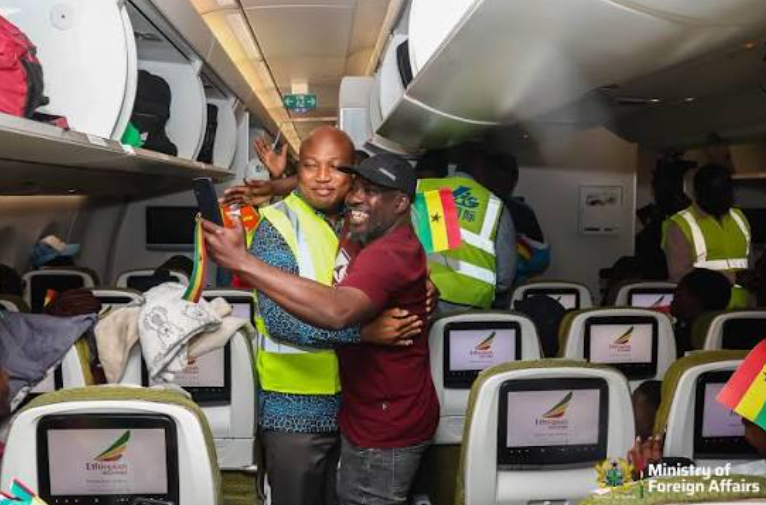
Chartered flights consumed GH¢27.18 million of the GH¢49.72 million used by government to evacuate Ghanaians from South Africa, emerging as the costliest component of the exercise.

The amount accounts for over half of the total spending on the operation, which airlifted 1,964 citizens home between May 27 and September 4, 2026.
The details were disclosed in documents issued by the Ministry of Foreign Affairs following a Right to Information request filed by the Minority in Parliament. Per the records, GH¢27,183,700 went into aircraft charters, with an additional GH¢9,420,463.68 spent on air tickets and transit costs.
Together, flight-related expenses exceeded GH¢36.6 million. A further GH¢10.802 million was disbursed as reintegration and travel support. Every returnee was given GH¢5,000 as a resettlement package plus GH¢500 for transportation, totalling GH¢5,500 per person.
Authorities explained that the cash support was meant to ease the immediate burden on the evacuees and assist them to restart their lives after leaving South Africa. Other costs captured GH¢997,644 for ground transport within South Africa, GH¢634,349.99 for meals and GH¢141,797.86 for hotel bills.
Medical care and hospital treatment cost GH¢20,148, while communication, including airtime, data and the setting up of an evacuation centre, amounted to GH¢153,728.09. Printing took GH¢98,151, and logistics such as sanitation and screening materials cost GH¢162,917.76. The conveyance and post-mortem of two bodies stood at GH¢84,274, with GH¢22,610.84 listed as sundry expenses.
Returnees were also offered complimentary health screening, NHIS enrolment, SIM cards with airtime and data, as well as food parcels. Psychosocial assistance, meals, water and logistical aid were provided by the International Organisation for Migration, NADMO and the Red Cross, while the Church of Pentecost housed stranded Ghanaians in Pretoria, Kempton Park and Johannesburg.
Of the total bill, government covered GH¢33,721,786, with Engineers and Planners, the firm owned by Ibrahim Mahama, donating GH¢16 million. Officials say all payments have been completed, leaving no arrears. The evacuation started on May 27, initially focusing on children, the sick, the elderly and women. It concluded on September 4 with the arrival of the last group of 41 people in Accra. Government described the exercise as an emergency intervention prompted by worsening insecurity and xenophobic hostility in parts of South Africa.
The release of the breakdown follows Minority demands for proof of the figures quoted by government, even as the Foreign Affairs Ministry has called for a special audit into all state-funded evacuations from 2017 to date, covering COVID-19, Ukraine, Sudan and South Africa.


