


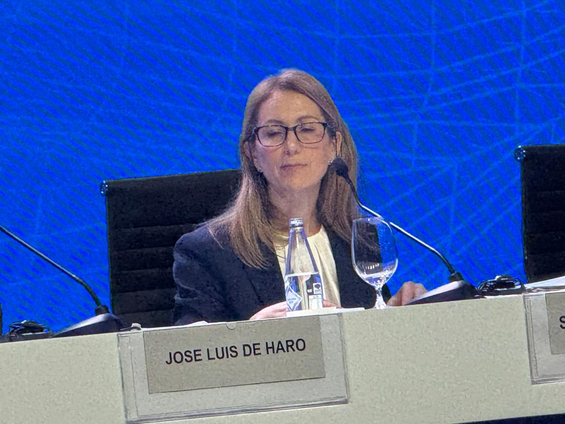
The International Monetary Fund (IMF) has raised Ghana’s economic growth forecast for 2026 to 5.7%, up from 4.6% projected in April, while lowering its year-end inflation outlook to 4.8%, reflecting improved economic prospects despite persistent global uncertainties.

The projections, contained in the Fund’s latest economic outlook report released on the sidelines of the IMF/World Bank Annual Meetings in Bangkok, Thailand, suggest a more optimistic assessment of Ghana’s economic performance than previously anticipated.
According to information available to Joy Business, the upward revision reflects the government’s commitment to fiscal discipline, targeted spending to stimulate economic activity and strong commodity export earnings, particularly from gold.
Higher gold export revenues have strengthened Ghana’s trade balance and helped build economic buffers. Progress towards targets under the IMF’s Policy Coordination Instrument (PCI) programme has also contributed to the improved outlook.
However, sources close to the Fund have cautioned against Ghana’s heavy reliance on gold exports, urging the government to diversify its export base to strengthen the economy’s resilience to external shocks.
The IMF expects economic growth to moderate to 5.2% in 2027.
Its 2026 growth projection exceeds the government’s estimate of 4.8% outlined in the 2026 Budget, signalling stronger expectations for the country’s economic performance.
Data from the Ghana Statistical Service show that the economy expanded by 6.0% year-on-year in the second quarter of 2026, bringing growth for the first half of the year to 6.2%.
Inflation outlook improves
The IMF has revised its projection for Ghana’s year-end inflation to 4.8%, down from the 7.9% forecast in April.
The new estimate is also below the government’s and Bank of Ghana’s medium-term inflation target band of 8% ± 2 percentage points, which ranges from 6% to 10%.
With inflation easing to 5.2% in September, the IMF’s projection suggests that price pressures could moderate further before the end of the year.
Bank of Ghana internal projections cited by Joy Business had anticipated an increase in inflation in September, while maintaining expectations that the year-end rate would remain within the target band.
If the IMF’s forecast materialises, Ghana will record single-digit year-end inflation for the second consecutive year, following a similar outcome in 2025.
The projected decline in inflation could provide further support for macroeconomic stability, although sustaining the gains will depend on fiscal and monetary discipline as well as developments in domestic and international markets.
World Bank maintains 4.8% growth forecast
The World Bank has maintained its 2026 growth forecast for Ghana at 4.8%, unchanged from its April projection, and expects the economy to expand by 4.9% in 2027.
In its October 2026 Africa Economic Update, the Bank identified services, a recovery in oil and gas activity, and continued structural and fiscal reforms as key drivers of economic growth.
It described economic activity in the second quarter as robust, although growth moderated slightly, with real gross domestic product expanding by 6.0% year-on-year.
On the expenditure side, strong domestic demand supported economic activity. Investment increased by 53.0%, while domestic demand rose by 11.2%, reflecting continued strength in private and public spending.
The difference between the IMF’s and World Bank’s projections highlights varying assessments of Ghana’s growth prospects, with the IMF adopting the more optimistic position for 2026.
Potential boost to investor confidence
The IMF’s improved outlook could strengthen investor confidence in Ghana’s economy and support efforts to attract foreign direct investment and additional financing from development partners.
Stronger growth and lower inflation could improve perceptions of macroeconomic stability, potentially creating a more favourable environment for investment and business expansion.
Ghana’s continued engagement with the IMF under the Policy Coordination Instrument could also reassure development partners about the government’s commitment to fiscal discipline and economic reforms.
The outlook follows recent credit rating upgrades by Moody’s and Standard & Poor’s, developments that could further improve perceptions of Ghana’s creditworthiness.
Taken together, the improved growth outlook, easing inflation and stronger credit ratings could help Ghana secure more favourable borrowing conditions and reduce the cost of future financing.
Such developments could also support the country’s eventual return to international capital markets, although actual borrowing costs will depend on market conditions, investor demand and the government’s fiscal position.
Global growth faces mounting risks
At the global level, the IMF said economic activity had remained resilient, supported by the technology upturn, existing economic buffers and adjustments that have helped cushion the effects of geopolitical disruptions.
However, the Fund expects global growth to slow to 3.1% in 2026 before recovering to 3.4% in 2027.
Global headline inflation is projected to rise to 4.7% in 2026 before easing to 4.1% in 2027. Energy-importing economies outside the technology value chain are expected to face particularly challenging conditions.
The IMF warned that the factors supporting global economic resilience have limits and that the risks to growth remain tilted to the downside.
An escalation of geopolitical conflicts, a reassessment of expectations surrounding artificial intelligence, renewed trade tensions and growing fiscal vulnerabilities could weaken global economic activity.
Conversely, stronger investment in artificial intelligence, productivity gains associated with new technologies, and a sustained easing of geopolitical and trade tensions could support faster growth.
The Fund also called for stronger fiscal frameworks to help governments respond to disruptive shocks and rebuild policy space through revenue-enhancing measures.
For Ghana, the improved outlook presents an opportunity to consolidate recent economic gains. However, sustaining growth, maintaining low inflation and reducing vulnerability to commodity price fluctuations will require continued fiscal discipline, export diversification and policies that support productive investment.


