


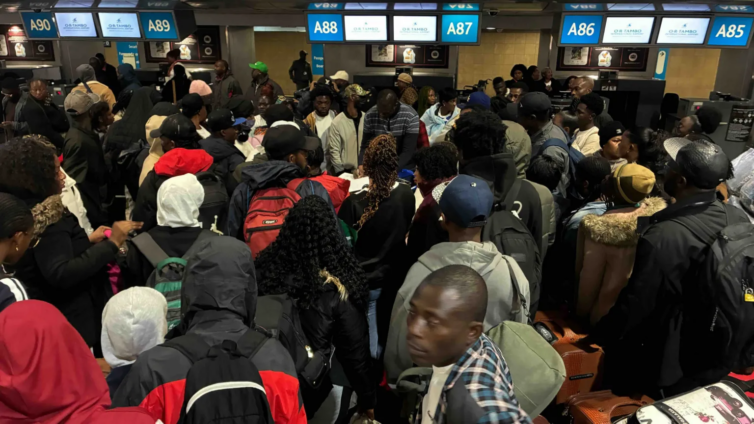
Vice President of policy think tank IMANI Africa, Kofi Bentil, has called on major South African multinational companies operating in Ghana to contribute financially to the evacuation of Ghanaians affected by reported afrophobic attacks in South Africa.

According to Mr. Bentil, it is unfair for the Ghanaian government alone to bear the cost of emergency repatriation efforts while South African companies continue to generate substantial profits from operations across the Ghanaian economy.
Speaking on TV3 on Saturday, May 30, 2026, the legal practitioner and policy analyst argued that corporate entities benefiting from African markets have a responsibility to demonstrate solidarity with victims of violence and support efforts aimed at protecting affected communities.
“Companies that make billions across Africa cannot remain silent when Africans are attacked in their home country. What the government is doing comes at a cost. They must bear part of the cost,” he stated.
Mr. Bentil maintained that requiring these businesses to assist with evacuation expenses would send a strong message that they reject violence and stand with Africans facing persecution.
Calls for Stronger National Response
The IMANI Africa Vice President also urged Ghana to adopt a firmer diplomatic approach toward South Africa, arguing that repeated attacks on Ghanaian nationals and other Africans should be treated as a serious matter of national concern.
“When citizens of a country are under attack, the country itself is under attack,” he said.
He commended the government’s efforts to evacuate affected Ghanaians and revealed that he had earlier encouraged authorities to organise emergency flights to bring citizens home whenever their safety could no longer be guaranteed.
Mr. Bentil further called for national unity in responding to the crisis, stressing that the protection of Ghanaian citizens abroad should rise above partisan political considerations.
“There are times when a nation must assert itself, and one of those times is when its citizens are under attack,” he added.
Rejecting Justifications for Violence
Addressing arguments that some victims may be undocumented migrants, Mr. Bentil insisted that immigration status cannot be used to justify violence or deny individuals protection under the law.
According to him, every country has a responsibility to guarantee the safety of all persons within its borders, regardless of their legal status.
“If anybody enters your territory, you have a responsibility to protect that person,” he argued.
He described the recurring nature of xenophobic and afrophobic attacks in South Africa as evidence of a deeper systemic problem that authorities must confront more decisively.
“When something happens once, it may be accidental. Twice may be a coincidence. By the third time, it becomes a pattern that demands accountability,” he said.
Criticism of the African Union
Mr. Bentil also criticised the African Union (AU), accusing the continental body of failing to take sufficiently robust action to address recurring violence against African migrants.
He argued that regional institutions must move beyond issuing statements and develop stronger mechanisms to protect citizens and hold member states accountable when human rights violations occur.
Economic Measures Should Be Considered
As part of a broader response, Mr. Bentil suggested that Ghana review aspects of its economic engagement with South African businesses if meaningful steps are not taken to end attacks on foreign nationals.
While emphasising that he was not advocating retaliation against South African citizens or businesses operating in Ghana, he argued that governments possess legitimate diplomatic, economic and regulatory tools to protect national interests.
According to him, future bilateral engagements and business arrangements involving South African companies should take into account how Ghanaians and other Africans are treated within South Africa.
“We must ensure that our citizens are respected wherever they are. There has to be accountability and there has to be consequences,” he concluded.
His remarks come amid growing concern over the safety of Ghanaians living in South Africa and ongoing efforts by the Ghanaian government to evacuate citizens who have registered to return home.


