


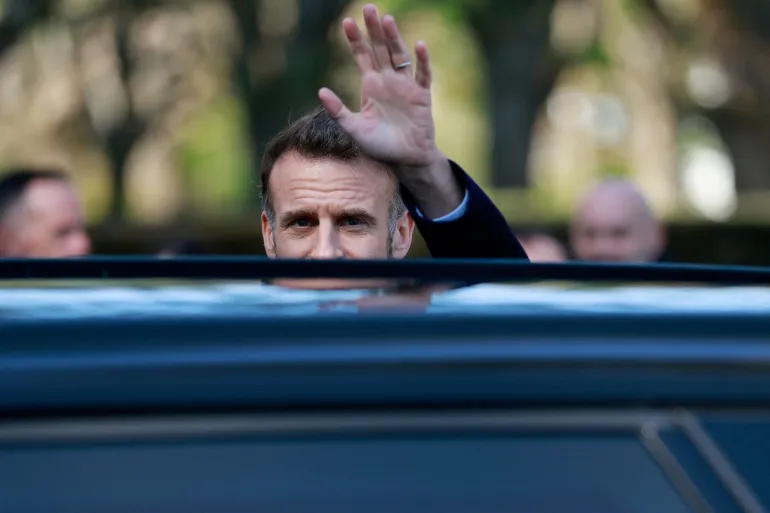
A couple of days after the United States and Israel launched their assault on Iran, French President Emmanuel Macron announced on March 2 that France would bolster its nuclear arsenal and strengthen ties with fellow European Union countries.

He called the policy “forward deterrence”.
With the speech, Macron demonstrated a show of strength in a rapidly changing world, where European allies are hesitant to rely on the US’s nuclear protection.
France currently has the fourth biggest nuclear arsenal in the world.
“What I want more than anything, as you will have understood, is for Europeans to regain control of their own destiny,” Macron said.
The declaration raises questions about Europe’s strategic future.
Some have described a watershed moment for European security, but the rhetoric is mainly a strong confirmation of France’s longstanding nuclear policy, according to geopolitical analyst Gregoire Roos.
“Ever since the French acquired nuclear weapons in the sixties, the French have a definition of the concept of vital interest that projects way beyond national borders,” Roos said. “The French have never thought of nuclear deterrence in an exclusively national context, at least from a geographical perspective … There’s always been a strong European dimension.”
France tends to be vague about the precise geographical extent of its “vital interests”, but its focus extends beyond the country’s borders.
“Macron heightened the fact that for France, the scope of vital interest was much larger than what many would think,” Roos said. “It also matters to remain ambiguous when it comes to the exact geographical scope of your vital interests.”
France’s ‘balancing act’
Macron’s policy reaffirms the doctrine of French nuclear strategy adopted by General Charles de Gaulle, the first president of the country’s Fifth Republic.
The Gaullist policy considered nuclear deterrence a protection for France’s territory and an assurance of political independence, Roos noted.
“This is a balancing act. The president reminded everyone that nuclear deterrence remained sovereign. There is no such thing as sharing nuclear codes or decisions on nuclear weapons,” Roos said.
Reaffirming ambiguity, France will stop communicating the number of their nuclear warheads. Currently, the country has approximately 290 warheads.
France also plans to collaborate more closely with the United Kingdom, the only neighbouring country with nuclear weapons, along with Germany, Poland, the Netherlands, Belgium, Greece, Sweden and Denmark.
“There’s a clear keenness and ability to project nuclear force outside of the national territory by positioning, for instance, French jet fighters carrying nuclear weapons on the territory of other European countries,” Roos said.
Nuclear programme decisions as Iran war rages
With escalating conflict in the Middle East, Iran’s nuclear programme is at the forefront of discussions.
While France opposes Iran acquiring nuclear weapons, Macron has condemned the US and Israel’s assault on the country, calling the strikes illegal and outside of international law.
“The French are very clear on the issue of Iran’s nuclear programme. But the threats emanating from the country can’t be solved militarily, let alone with regime change,” Laure Foucher, a researcher at the French think tank Foundation for Strategic Research, or FRS, told Al Jazeera.
“The [French] have always favoured a diplomatic solution to the nuclear issue in Iran,” Foucher added.
France has a tangled history with Iran.–Al Jazeera


