


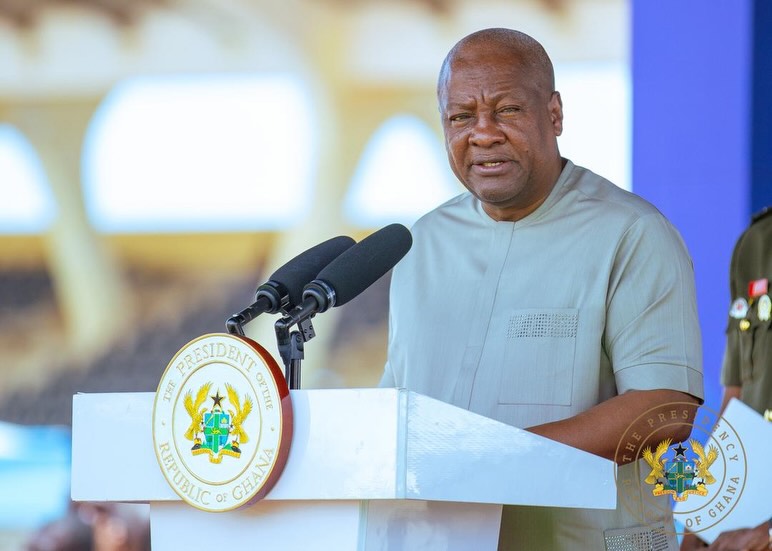
President John Dramani Mahama has announced that the government has secured a $300 million facility from the World Bank to upgrade 50 senior high schools nationwide as part of efforts to improve access, quality, and relevance in secondary education.

Speaking at the commissioning of a PET Scan machine at the Swedish Ghana Medical Centre, President Mahama said the initiative, known as the Transformative Secondary Education for Access, Results and Relevance for Jobs (STARR-J) project, is expected to play a key role in ending the Double Track system by 2027.
“The STARR-J project is going to assist the Ghana government achieve its target of bringing an end to double track in our secondary school system by next year. By 2027, there should be no secondary school implementing a double track system in Ghana,” the President stated.
According to him, the project will involve upgrading 30 Category C senior high schools to Category B status, while 20 Category B schools will be elevated to Category A.
“This strategic investment is not simply about expanding infrastructure. It is fundamentally about promoting equity, improving quality, and widening opportunities for every Ghanaian child,” he said.
President Mahama also disclosed that new E-block community day schools would be constructed in urban and peri-urban communities to reduce pressure on boarding facilities and expand access to secondary education.
“So what this means is that if we get some of the children to go to school within their communities, it will ease the pressure on the boarding schools that are elsewhere,” he explained.
He noted that the schools would be strategically located in communities where students can conveniently commute between home and school.
Beyond infrastructure development, the President said the STARR-J initiative would also prioritise improvements in teaching and learning, particularly within technical and vocational education.
“As part of this initiative, all teachers in our secondary schools will benefit from continuous professional development programmes designed to sharpen their skills and improve classroom effectiveness,” he stated.
He added that the training programmes would equip teachers with “21st century competencies, including digital literacy, critical thinking, innovative pedagogical approaches, artificial intelligence integration, and learner-centred teaching.”
President Mahama further praised teachers for their contribution to national development, describing education as the “bedrock of national development.”
“Behind every successful doctor, every successful engineer, entrepreneur, public servant, scientist, and let me add, behind every president, there stands a teacher who inspired, nurtured and guided them on that journey,” he remarked.
The President also highlighted recent reforms in career progression within the teaching profession, noting that government had introduced measures allowing teachers to advance based on merit, competence, experience, and performance rather than solely on the availability of administrative positions.
“This reform ensures that excellence in the classroom is recognized and rewarded, whilst strengthening professionalism, morale, and dignity across the teaching service,” he added.
Meanwhile, the newly commissioned PET Scan machine at the Swedish Ghana Medical Centre is expected to significantly enhance advanced diagnostic healthcare services in Ghana.
A PET Scan, or Positron Emission Tomography scan, is an advanced imaging technology used to detect and monitor diseases such as cancer, heart disease, and brain disorders by showing how tissues and organs function inside the body. The technology helps doctors identify diseases early, improve treatment planning, and monitor patients’ responses to treatment.


