


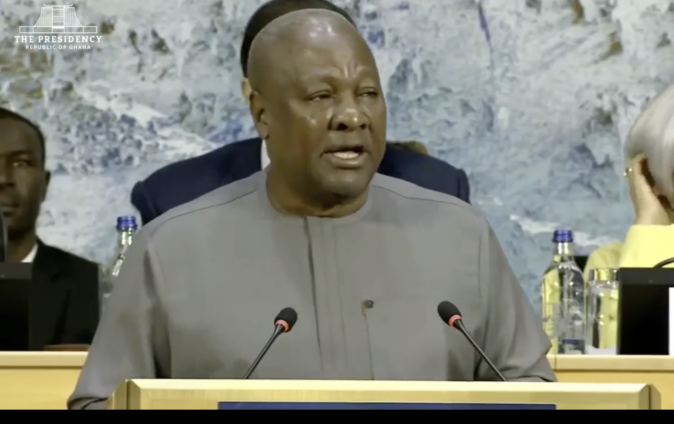
John Dramani Mahama has called for urgent reforms to the global health system, warning that geopolitical tensions and declining donor support have exposed major weaknesses in international health cooperation.

Addressing delegates at the 79th World Health Assembly in Geneva, President Mahama said the world could no longer rely on a fragile health financing structure vulnerable to political and economic disruptions.
“The World Health Organisation’s budget has been gutted by the withdrawal of US assistance, forcing the organisation to scale down programmes and undertake steep staff retrenchments,” he stated.
According to the President, global humanitarian assistance has declined by about 40 per cent, while several major Western economies have significantly reduced overseas development aid.
He argued that these developments have created uncertainty over the future of healthcare delivery, particularly in low and middle-income countries that depend heavily on donor-funded programmes.
President Mahama noted that African countries were already experiencing the consequences of the funding cuts, citing Ghana’s loss of approximately $78 million in health support and disruptions to HIV programmes in South Africa following reductions in PEPFAR funding.
He warned that millions of lives could be placed at risk if governments and international institutions fail to respond decisively.
“These troubling statistics are known, and we’re not here to lament or wring our hands over them,” he told the Assembly. “We’re here to decide whether the architecture we supervise is still fit for purpose.”
The President said his administration remained committed to strengthening resilience within Ghana’s health sector despite the difficult global environment.
He linked the current challenges to discussions held during the African Health Sovereignty Conference, also known as the Accra Reset, which brought together African leaders and policymakers to explore strategies for reducing dependence on external health financing.
The World Health Assembly serves as the decision-making body of the World Health Organization and convenes health ministers and heads of state from member countries to deliberate on global health priorities and policy reforms.
President Mahama’s remarks add to growing calls from African leaders for increased domestic investment in healthcare, expansion of local pharmaceutical manufacturing and reforms to global financing systems to ensure long-term sustainability.


