


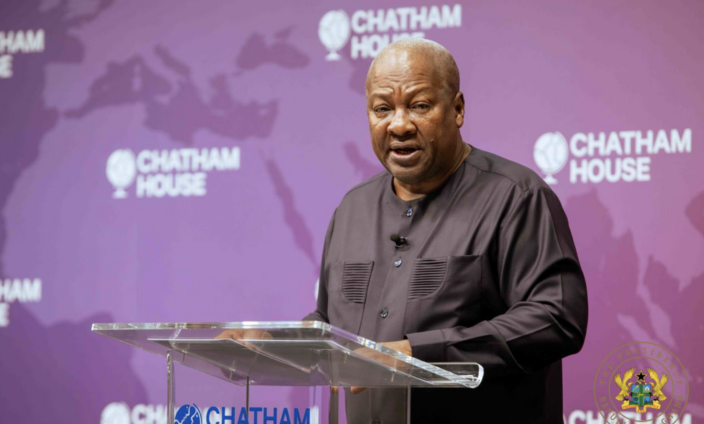
President John Dramani Mahama has renewed Ghana’s call for comprehensive reform of the United Nations, urging the international community to grant Africa permanent representation on the UN Security Council and describing the continent’s continued exclusion as a historical injustice.

Speaking at Chatham House in London on the theme, “Navigating a Changing Global Order: Ghana’s Strategic Priorities,” President Mahama argued that global governance institutions must evolve to reflect contemporary political realities rather than the power structures established in 1945.
According to the President, the legitimacy of the international system cannot be sustained while large segments of humanity remain underrepresented in global decision-making processes.
He noted that Africa, which comprises 54 member states of the United Nations and is projected to account for nearly a quarter of the world’s population by 2050, continues to lack permanent representation on the UN Security Council.
“This is not merely a procedural anomaly; it is a historical injustice and a structural imbalance that undermines the credibility of the multilateral system itself,” President Mahama stated.
He reaffirmed Ghana’s support for comprehensive reforms of the United Nations, including equitable representation for Africa on the Security Council.
Reflecting on the post-1945 international order, the President acknowledged that despite its imperfections, it established important norms and institutions that contributed to relative global stability. He cited principles enshrined in the UN Charter, including sovereign equality, territorial integrity, peaceful settlement of disputes, non-interference, and the collective pursuit of peace and development.
According to him, these principles provided the foundation upon which many formerly colonised nations, including Ghana, achieved independence and asserted their sovereignty.
However, President Mahama expressed concern that many of these norms are increasingly being undermined.
“Today, many of these norms are on the street. We increasingly witness a selective application of international law, the erosion of multilateral consensus, and the growing tendency for strategic competition to take precedence over collective responsibility,” he said.
The President noted that conflicts across various regions continue to test the credibility of the international system, exposing weaknesses in institutions designed to maintain global peace and security. He also highlighted concerns over unmet climate financing commitments and declining development assistance to many regions.
He observed that while the world is becoming more technologically interconnected, it is simultaneously experiencing increasing political fragmentation.
For countries in the Global South, President Mahama said the critical issue is no longer whether the international order is changing, but how nations can navigate the transition effectively.
“The question is how to navigate this transition with resilience, strategic clarity, and sovereign confidence,” he remarked.
The President stressed that Ghana’s response to these global changes is not based on retreat or passivity but on purposeful engagement with the international community.
He outlined four key strategic priorities guiding Ghana’s approach to the evolving global landscape: reforming global governance institutions, advancing African integration, building balanced and mutually beneficial international partnerships, and strengthening the country’s sovereign capacity to determine its own development path.
President Mahama said these priorities would position Ghana to respond effectively to emerging global challenges while safeguarding its national interests and contributing meaningfully to international cooperation.


