


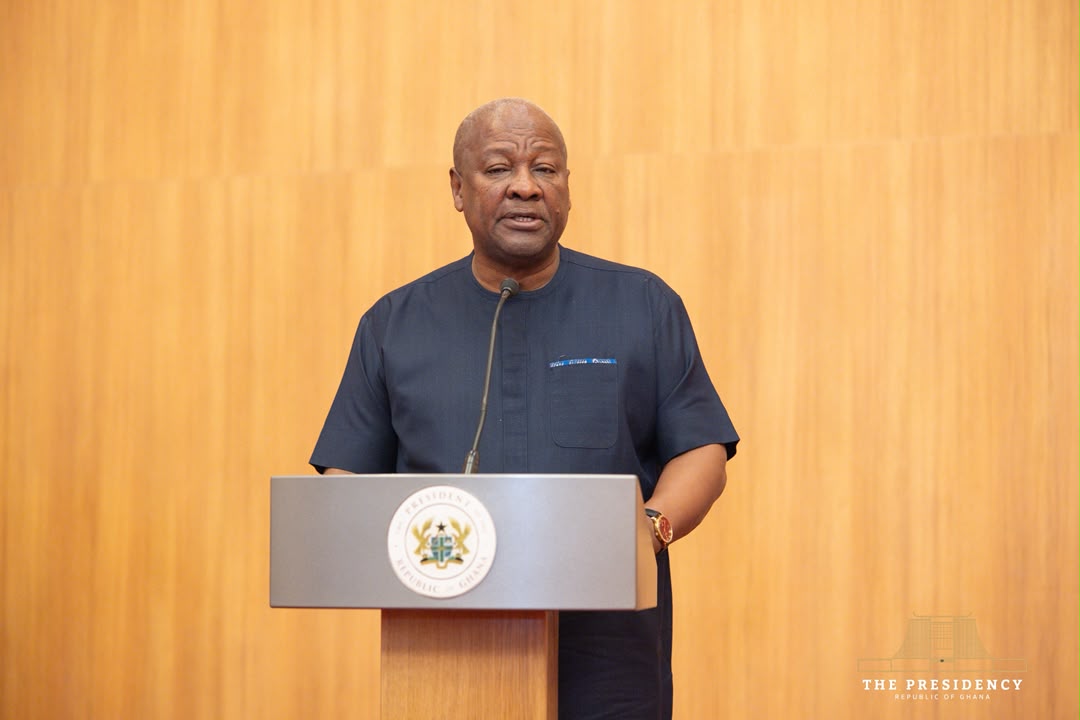
President says $10bn Big Push will fund infrastructure over five years, while another $10bn in planned investments will target job-creating sectors over four years.

President John Dramani Mahama has outlined his administration’s infrastructure and economic investment plans, touting the $10 billion Big Push Infrastructure Programme as a major driver of job creation, national development and the completion of stalled projects.
Speaking at the 13th Financial Times (FT) Africa Summit in London, President Mahama said the Big Push would be implemented over five years, with $2 billion allocated annually to accelerate infrastructure development across the country.
“We are building infrastructure through the Big Push Programme. It is a $10 billion programme over five years, with $2 billion allocated each year,” he said.
The President explained that the programme, which initially focused on road infrastructure, would be expanded to include schools, hospitals, irrigation schemes and other projects considered essential to national development.
He said the initiative was expected to generate hundreds of thousands of jobs while addressing infrastructure gaps and advancing the government’s development agenda.
New $10bn investment plan targets job creation
President Mahama also announced plans for a new economic programme involving $10 billion in self-financed investment over four years.
The proposed investments will target nine job-rich sectors, including tourism, energy, agriculture, agro-processing, pharmaceuticals, and textiles and garments.
He attributed the planned investment drive to fiscal adjustments being undertaken by his administration, including a reduction in the primary balance target agreed with the International Monetary Fund (IMF) from 1.5 per cent to 0.5 per cent.
According to the President, the adjustment would create additional fiscal space equivalent to one percentage point, which the government intends to channel into targeted sectors to stimulate economic activity and employment.
“However, the economy is holding steadily. Our currency is stable, and interest rates are still falling. I think there is a lot we can do for ourselves, even as we call for reform of the global order,” he said.
Mahama calls for reforms to global financial system
The President made the remarks during the two-day FT Africa Summit, held under the theme Mobilising Growth in a New Global Order.
The summit brought together business leaders, policymakers and heads of state to discuss economic growth, investment and development across Africa.
Addressing the continent’s debt burden and the international financial system, President Mahama argued that the existing global economic order placed African countries at a disadvantage, particularly in securing affordable financing to address climate change.
He highlighted what he described as the disproportionate financial burden African countries face despite contributing relatively little to global greenhouse gas emissions.
“We contribute just four per cent of greenhouse gas emissions, yet we borrow at eight times the cost to deal with the effects of flooding, forest fires and other climate-related challenges,” he said.
President raises alarm over financial outflows
President Mahama also drew attention to the substantial financial resources leaving Africa through debt servicing and illicit financial flows.
He cited estimates suggesting that approximately $80 billion leaves the continent annually through interest payments and debt repayments, while another $90 billion is lost through illicit financial flows, transfer pricing and related practices.
He further expressed concern about declining Overseas Development Assistance (ODA), noting that it fell by 23.5 per cent in 2025 and was expected to decline further in 2026.
Despite these pressures, he described Africa as resilient, arguing that the continent continued to face significant financial outflows at a time when development assistance was shrinking.
“More than $200 billion goes out every year while ODA continues to dwindle,” he said, questioning how Europe would have managed under similar circumstances.
Push for greater economic self-reliance
The President’s remarks underscored his administration’s emphasis on infrastructure investment, domestic economic mobilisation and job creation, alongside calls for reforms to the global financial system.
Through the Big Push programme and the proposed investment plan, the government aims to expand infrastructure, strengthen productive sectors and create employment opportunities.
At the international level, President Mahama argued that African countries also needed a fairer financial system that would allow them to retain more resources for development and access affordable financing to address economic and climate-related challenges.


