


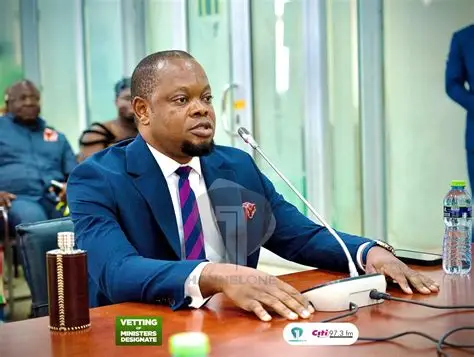
The Deputy Attorney General and Minister for Justice, Justice Srem-Sai, has rejected claims of friction between the Attorney-General’s Department and the Office of the Special Prosecutor (OSP), stating that government will provide prosecution approval whenever it is officially sought.

In a conversation on Joy FM on Friday, April 17, which was monitored by the Ghanaianradar he said the matter under discussion was not a lack of cooperation, but rather institutional process and the OSP’s stance on autonomy. “Why not? Why won’t we grant them the authorisation if they apply for it? We have been liaising with the Office of the Special Prosecutor since we came to office,” he said.
Mr. Srem-Sai added that interaction between the two bodies has been continuous, emphasising that collaboration has not collapsed.
“There are so many things that we have done, some of which I cannot account for. So there’s no issue about liaising or not liaising. Why won’t we? That’s the question I am asking,” he stated.
He, however, pointed out that the OSP has not requested such approval, arguing the office holds that it does not need consent because of its independence.“ OSP is not interested in coming for the authorisation. That is because the OSP says that it is independent and doesn’t require the authorisation. That is the issue at the centre of it,” he explained.
According to him, the discussion should not be reduced to whether approval was being given or denied but viewed within the wider context of the Special Prosecutor’s constitutional autonomy.“
“The whole argument is the independence of the Special Prosecutor, which is at the core of this issue. So if you simplify the matter and you say that it’s just about giving authorisation and not giving it, then you probably have completely left the issue aside and you’re addressing a completely different issue,” he added.
His remarks follow a High Court decision on Wednesday, April 15, 2026, which directed the Attorney-General’s Department to assume all criminal prosecutions currently managed by the OSP, until formal approval was issued by the Attorney-General’s office.
The decision temporarily transfers ongoing prosecutorial duties to the Attorney-General’s Department. It also means the OSP cannot proceed with those matters in court as they stand.The court further ruled the present OSP prosecutions “null and void,” opening the chance that the cases may have to be refiled or restarted under the Attorney-General’s authority, depending on the state’s next steps.


