


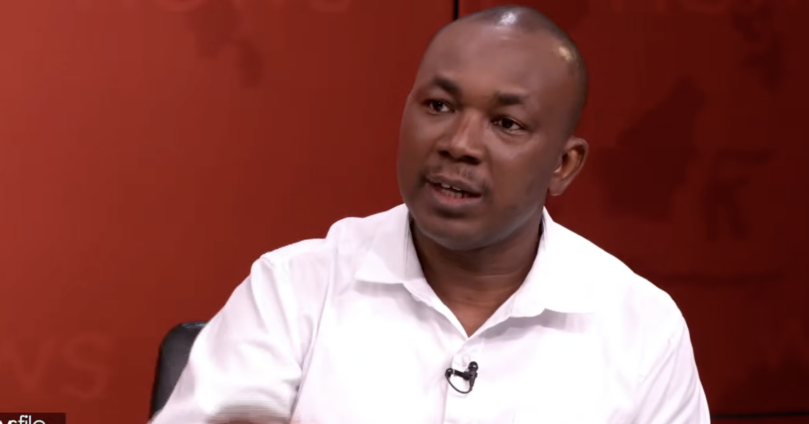
Professor of Finance and Economics at the University of Ghana, Godfred Bokpin, has warned that Ghana’s economic recovery will not be sustainable unless the government addresses major structural challenges, particularly environmental destruction caused by illegal mining.

Speaking on Joy FM’s Super Morning Show on Thursday, May 21, Prof. Bokpin said the government must adopt a broader and more comprehensive approach to economic management rather than focusing solely on fiscal targets.
“If the government wants to do well, they cannot pick and choose where they want to succeed. They must address this comprehensively, because we are just kicking the can down the road,” he said.
Prof. Bokpin made the remarks during a discussion on the long-term sustainability of Ghana’s economy and the country’s continued reliance on programmes supported by the International Monetary Fund (IMF).
Responding to questions about whether Ghana could maintain economic stability if government remained fiscally disciplined ahead of the 2028 general elections, the economist cautioned that the country remains vulnerable despite recent gains.
“Our projection is that by 2032, 2033, Ghana will be fully ready for another IMF programme,” he stated.
According to him, economists had previously recommended that Ghana adopt a Policy Support Instrument, now known as the Policy Coordination Instrument (PCI), after exiting an earlier IMF programme in 2019.
“What the government has decided to do in 2026 was a recommendation we made in 2019,” he noted.
However, Prof. Bokpin stressed that participation in the PCI alone would not guarantee long-term economic stability.
“Signing up for policy instruments again will not be sufficient for Ghana,” he warned.
He urged the government to use the PCI as a pathway to access the IMF’s Resilience and Sustainability Facility (RSF), which supports countries dealing with climate and environmental risks.
“What government needs to do right now is to be bold,” he said.
According to him, the facility could provide critical financial support for addressing illegal mining, environmental degradation, and coastal erosion.
“The RCF would empower us to address our environmental and irresponsible mining [issues] and then fight the threat of coastal erosion,” he explained.
Prof. Bokpin suggested that government may have hesitated to aggressively clamp down on illegal mining because of concerns that disruptions in gold production could weaken the cedi and create balance-of-payment pressures.
However, he argued that access to the IMF facility would provide a financial cushion against such shocks.
“Once you sign up for this RCF, the resilience and sustainability facility, it gives you room, a financial backing that you can tap into,” he stated.
The economist also expressed concern over the growing pollution of water bodies, particularly in key agricultural regions.
“More than 40% of water bodies in Ghana’s food basket regions in the south are all polluted,” he revealed.
He warned that Ghana cannot pursue long-term fiscal sustainability while environmental destruction continues unchecked.
“You cannot talk about fiscal sustainability in the face of all this risk emerging,” he said.
Prof. Bokpin further argued that economic transformation and environmental protection are inseparable.
“There is no way we can separate the environment, ecological integrity, from economic transformation. It’s a joke,” he added.


