


The Social Security and National Insurance Trust (SSNIT) has explained its decision to seek the removal of structures and unauthorised occupants from the beachfront adjoining the Labadi Beach Hotel and La Palm Royal Beach Hotel in Accra.

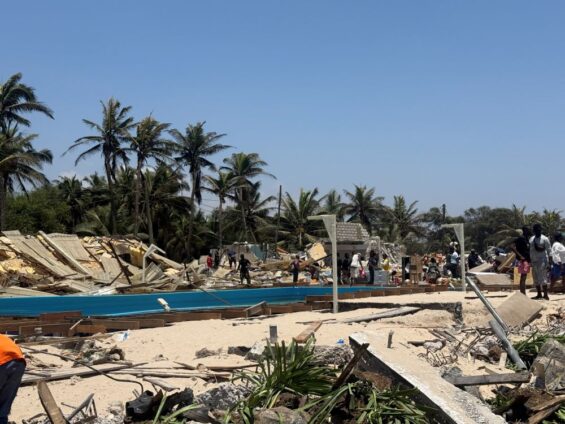
The clarification follows a demolition exercise on Friday, October 2, which affected several structures and businesses along the La Beach area, including La Pleasure Beach and Polo Beach Club.
The operation, involving personnel from the 48 Engineer Regiment of the Ghana Armed Forces and the Ghana Police Service, began in the early hours of Friday. Security personnel directed workers, traders, residents and operators to vacate the area, after which several structures were demolished or partially pulled down.
In a statement issued on Friday, October 2, SSNIT said it had sought the urgent intervention of the National Security Council Secretariat to address what it described as the “persistent unlawful occupation, encroachment, and unauthorised activities” on the beachfront adjoining and directly in front of the two hotels.
SSNIT said Labadi Beach Hotel and La Palm Royal Beach Hotel form part of its investment portfolio and constitute significant national hospitality and tourism assets.
It said it therefore had a fiduciary responsibility to protect the investments, preserve their value and ensure they continue to generate sustainable returns for contributors and pensioners under the Basic National Social Security Scheme.
“These assets belong to the workers and pensioners of Ghana,” SSNIT stated.
Why SSNIT sought National Security intervention
According to SSNIT, the continued encroachment on the beachfront posed several risks to the hotels and their operations.
The Trust cited concerns about the safety and security of hotel guests, employees, service providers and visitors, as well as unauthorised access and the proximity of occupants to sensitive guest and operational areas.
It also identified increased exposure to fire, sanitation, environmental and public health hazards as concerns associated with the continued occupation of the beachfront.
SSNIT said the situation had affected the condition of the beachfront, the privacy of the hotels and the service standards expected of internationally recognised hospitality facilities.
The Trust further raised concerns about degradation of the coastal ecosystem, particularly through construction activities and the use of beach sand.
It said the situation could also cause reputational damage to the hotels, SSNIT and Ghana’s tourism industry.
Other concerns included possible disruption to hotel operations and the beach experience for guests, which SSNIT said could affect patronage, revenue and the hotels’ overall financial performance.
The Trust also cited the risk that further expansion of the encroachments could make recovery of the affected areas increasingly difficult and costly.
“In view of the foregoing, SSNIT requested support from National Security to protect the assets belonging to Ghanaian workers,” the statement said.
Demolition not part of flood mitigation exercise
The demolition initially raised questions about whether the exercise formed part of the government’s ongoing flood mitigation operations in parts of Accra.
Deputy Chief of Staff in charge of Operations, Stan Dogbe, subsequently clarified that Friday’s operation was separate from the government’s flood mitigation exercise.
He said the operation was carried out under the supervision of National Security at the request of the Labadi Beach Hotel.
According to Mr Dogbe, the structures affected, including the Polo Beach Club and other permanent structures, were located on the beach in front of the hotel.
He said the hotel had raised concerns that the structures were affecting its safety, tranquillity and reputation, while diminishing the visitor experience.
Mr Dogbe also distinguished the exercise from the work of the government’s National Flood Mitigation Task Force at locations including the Kpeshie Lagoon, East Legon Boundary Road, Oyarifa and behind Mayfair Estates.
He said there were also broader sanitation and security concerns associated with unauthorised and unregulated commercial activities along the beachfront.
Beachfront to remain open to public
SSNIT said the exercise was not intended to prevent the public from accessing the beach.
The Trust said the affected areas would be cleaned and restored to a safe and desirable condition.
“The beaches will be cleaned and restored to a safe and desirable state and will remain open to the public,” SSNIT stated.
The Trust did not announce plans in its statement to convert the cleared beachfront into a private facility or restrict public access.
Instead, it said the intervention was aimed at protecting the hotels and the underlying investments while addressing the issues it had identified on the beachfront.
Concerns over impact of demolition
The exercise has nevertheless affected a number of businesses and workers operating in the area.
La Dadekotopon MP Rita Naa Odoley Sowah confronted military personnel at La Pleasure Beach and questioned the basis for the exercise.
She said she had engaged authorities over the planned demolition and had been assured that structures around the Labadi Beach Hotel would not be affected.
Some operators also complained about the destruction of their businesses and property, while affected workers were seen salvaging belongings from demolished structures.
The demolition followed earlier clearance activities in parts of the La Beach area, including structures at Laboma Beach.
Officials, however, have stressed that Friday’s operation near the Labadi Beach Hotel should not be conflated with the government’s separate flood mitigation programme.


