


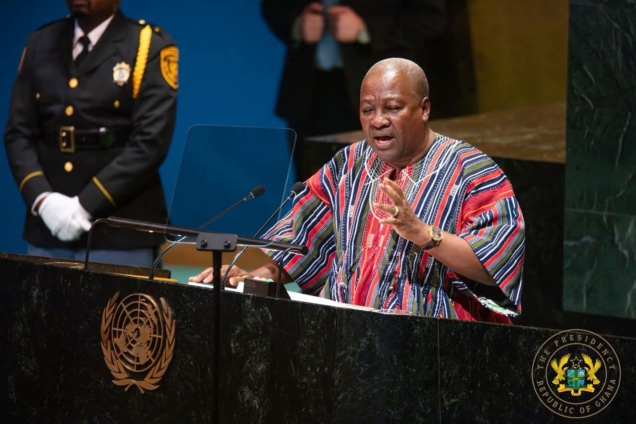
President John Dramani Mahama has called for a global rethink of how slavery is discussed, declaring that the transatlantic slave trade was deliberately designed to deny Africans their humanity.

Speaking at a United Nations event on a resolution on slavery at the United Nations headquarters on Tuesday, March 24, Mahama challenged the language historically used to describe the enslaved, arguing that it distorts the lived experiences of millions of Africans.
“Truth begins with language, with the power that words hold to shape consciousness and to shift perspectives,” he said. “There’s no such thing as a slave. There were human beings who were trafficked and then enslaved by people who believed they could own those human beings as their personal property.”
He emphasised that the distinction is not mere semantics. Referring to individuals as “slaves” rather than recognising them as human beings who were enslaved perpetuates the dehumanisation central to the system.
“The entire transatlantic slave trade was designed to deny African people their humanity,” Mahama said. “That denial was premised on a racial hierarchy with no basis in fact or science — one that deemed whiteness superior and blackness inferior.”
Mahama highlighted that the atrocities inflicted during slavery and the inequalities that followed were made possible because enslaved people were treated as objects rather than human beings.
“The injustices committed against Africans took place specifically because they were considered objects, not human beings,” he noted.
He called for a reframing of global discourse on slavery, insisting that discussions begin with reclaiming the dignity and humanity of Africans and their descendants.
“When discussing slavery and its resulting institutions and practices, we must always start by reclaiming racial equality, the dignity of Africans, the humanity of our ancestors who were enslaved — and, as a matter of course, our own humanity,” he said.
The remarks formed part of broader UN deliberations on the historical and enduring impact of slavery, where calls for justice, recognition, and systemic change continue to shape global conversations.


