


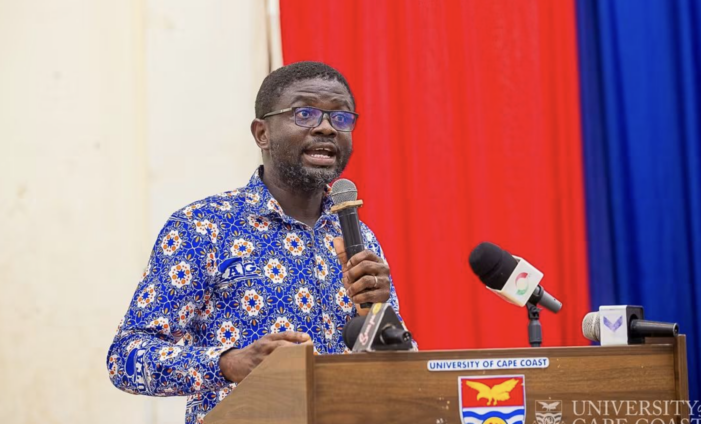
The University of Cape Coast (UCC) Chapter of the University Teachers Association of Ghana (UTAG) has called on the Ghana Tertiary Education Commission (GTEC) to respect university autonomy and focus on its statutory responsibilities rather than interfering in the internal affairs of tertiary institutions.

The Association acknowledged GTEC’s contribution to Ghana’s education sector but expressed concern that the Commission had, on several occasions, exceeded its regulatory boundaries, undermining academic freedom and disrupting university activities.
The call was made at the 2026 UTAG Experts’ Forum, held under the theme: “Rethinking Autonomy, Power and Oversight: GTEC’s Regulatory Authority and the Politics of Academic Freedom in Ghanaian Universities.”
Speaking at the forum, Professor Philip Ebow Bondzi-Simpson, a senior member of UCC’s Faculty of Law, argued that GTEC’s statutory responsibilities extended beyond regulation to include advising, coordinating and accrediting tertiary institutions.
He maintained that the Commission had not executed these responsibilities effectively and efficiently, adding that a stronger focus on its core mandates would help prevent it from venturing into matters beyond its legal authority.
Prof. Bondzi-Simpson stressed that GTEC’s Director-General, deputies, directors and other staff were required to operate within their legally defined mandates and implement decisions of the Commission’s governing council.
He warned that any exercise of authority without a clear legal basis could be deemed unlawful.
“The mandate must always precede the assertion of authority, and if that is not done, the exercise by the director general or a deputy director general or any director or staff on his behalf is ultra vires,” he said.
He further argued that the law did not require GTEC to sit on university councils, describing such membership as a potential conflict of interest because the Commission could participate in institutional decisions and subsequently regulate or challenge those same decisions.
“Because a regulator cannot be sitting on council; council is a governing council that makes decisions about the university, participating in the process while wearing one hat. Then in the next hat, it will go and negate or undermine those decisions,” he stated.
Using a sporting analogy, Prof. Bondzi-Simpson said a regulator should not be involved in selecting a team’s coach, players and captain before assuming the role of referee.
He also suggested that GTEC’s frequent portrayal as a “policeman” in public discourse contributed to its approach to regulation. He argued that greater emphasis on its advisory, coordinating and accreditation functions could encourage a more collaborative relationship with universities.
UCC Vice-Chancellor calls for constructive engagement
The Vice-Chancellor of UCC, Prof. Denis Worlanyo Aheto, shared similar concerns, calling on GTEC to respect the autonomy of universities and avoid unnecessary interference in legitimate academic decisions.
He advocated a regulatory framework that promotes accountability and safeguards academic standards while allowing universities the freedom to manage their academic affairs.
However, he challenged universities to exercise academic freedom responsibly, insisting that institutional autonomy must be accompanied by sound governance, ethical conduct and institutional integrity.
“Our goal should not be to weaken GTEC or diminish the authority of universities. Rather, we should build a relationship of constructive engagement in which regulatory authorities and universities understand their respective mandates and work collaboratively towards excellence in higher education,” he stressed.
VCG raises concerns over regulatory directives
Dr Cynthia Sena Kpeglo-Freiku, Executive Secretary of Vice Chancellors Ghana (VCG), also raised concerns about regulatory directives affecting staff appointments, internal organisational structures, retirement arrangements and the development of academic programmes.
She said excessive regulatory interference could delay recruitment, create teaching gaps, increase administrative costs and disrupt academic delivery.
Dr. Kpeglo-Freiku called for a review of overlapping legal mandates, meaningful consultation with affected institutions, transparent regulatory procedures and a permanent mechanism for dialogue and dispute resolution.
“Strong universities require effective regulation. Effective regulation requires institutional trust, and institutional trust requires accountability on both sides,” she said.
Prof Appiagyei-Atua advocates constitutional checks
Prof. Kwadwo Appiagyei-Atua, Regional Director of the African Coalition for Academic Freedom, argued that GTEC’s regulatory powers should be assessed against the provisions of Ghana’s Constitution.
He proposed the development of legislative instruments through broad consultations involving government, academic unions and students to prevent arbitrary directives and protect university autonomy.
He also called for a review of GTEC’s Board composition to ensure balanced representation, including academic unions and student representatives, in order to limit excessive executive influence and strengthen democratic decision-making in higher education regulation.
“My recommendation is that it should not be done by the Minister alone. It should involve academic unions like UTAG, CETAG, and student representatives so that we all sit around the table, consult among ourselves, and agree on the details of the law,” he said.
UTAG calls for stronger collaboration
The UCC UTAG President, Prof. Jerry Opoku Ansah, said the annual experts’ forum provided a platform for objective discussions on local, national and global issues, the presentation of informed policy alternatives and contributions to development at various levels.
Addressing the forum’s theme, he noted that universities had a responsibility to uphold academic standards, maintain academic freedom and produce well-trained graduates.
He acknowledged, however, that regulation remained necessary to protect the quality of higher education and maintain public confidence in tertiary institutions.
Prof. Opoku Ansah therefore called for a more collaborative relationship between universities and GTEC, emphasising the need for both parties to understand their respective responsibilities and work together to improve higher education in Ghana.


