


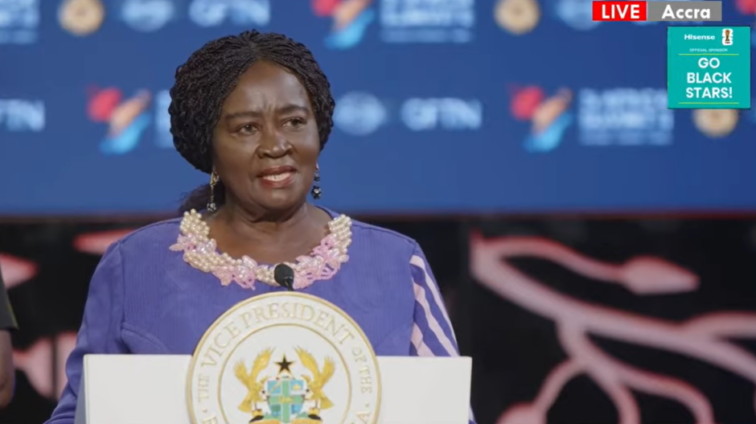
Vice President Naana Jane Opoku-Agyemang has identified payments, identity, regulation, and infrastructure as the four critical pillars Africa must strengthen to achieve full digital integration and unlock the potential of cross-border trade.

Speaking at the 3i Africa Summit 2026 in Accra, she noted that while the continent has made notable progress in areas such as mobile money, digital identity, and financial technology, these gains remain fragmented.
“Africa has already demonstrated a capacity to move beyond legacy systems… The task is to move from pockets of progress to continental scale,” she stated.
On payments, the Vice President highlighted persistent inefficiencies in intra-African transactions, observing that many are still routed through financial systems outside the continent and denominated in foreign currencies. She warned that this practice increases costs, causes delays, and undermines the vision of a unified African market.
She pointed to initiatives such as the Pan-African Payment and Settlement System as steps in the right direction but emphasised the need for more seamless, cost-effective cross-border payment systems. The goal, she explained, is to enable African businesses to transact directly in local currencies with minimal friction.
Addressing identity, she underscored its foundational role in building trust within a digital economy. She noted that millions of Africans still lack verifiable digital identities, limiting their access to services and participation in cross-border trade. According to her, interoperable identity systems are essential to expanding inclusion at scale.
On regulation, she stressed that harmonisation does not require identical legal frameworks but rather compatibility across jurisdictions. Fragmented regulatory environments, she cautioned, increase the cost of doing business and stifle innovation. She called for enhanced coordination through shared standards, regulatory sandboxes, and practical collaboration among African states.
Referencing the African Continental Free Trade Area Digital Trade Protocol, she urged policymakers to build on existing frameworks with disciplined implementation and alignment efforts.
Turning to infrastructure, the Vice President identified significant gaps in connectivity, affordability, and digital skills across the continent. She also highlighted Africa’s limited share of global data centre capacity, warning that reliance on external data storage and processing undermines digital sovereignty.
“Investment in broadband, cloud infrastructure, and digital systems must therefore accompany regulatory and policy alignment,” she noted.
Concluding, she urged African governments to act decisively in leveraging the continent’s demographic advantages and accelerating technology adoption. She emphasised that Africa’s youthful population and expanding digital ecosystem position it to play a central role in the next phase of global digital growth.


