


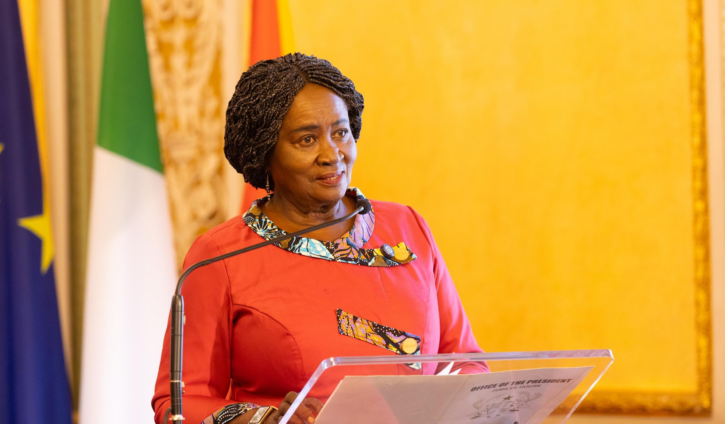
Jane Naana Opoku-Agyemang has delivered a strong critique of the international geopolitical order, describing the current system of global governance as fundamentally imbalanced and unrepresentative of contemporary global realities.

Speaking at the Oxford Africa Conference 2026 on Saturday, 16 May 2026, the Vice President argued that the continued exclusion of African countries from key global decision-making structures undermines the democratic values that many Western institutions claim to uphold.
Addressing participants at the Andrew Wiles Building, Professor Opoku-Agyemang stated that the existing global governance framework no longer reflects the present distribution of international power and influence.
She linked the legitimacy of institutions such as the United Nations directly to their willingness to undertake meaningful reforms, particularly regarding representation on the UN Security Council.
For decades, African leaders have advocated permanent African representation on the Security Council, which remains dominated by the powers that emerged victorious after the World War II.
The Vice President warned that Africa’s patience with the slow pace of reform is diminishing.
“If institutions and democracy are to remain legitimate, they must remain responsive to contemporary realities,” she stated.
She added that the absence of meaningful African representation within major global decision-making structures, especially the UN Security Council, continues to create a growing imbalance between the distribution of global power and the structures through which that power is exercised.
Professor Opoku-Agyemang further argued that legitimacy in global governance extends beyond representation alone and must also be measured by outcomes.
Expanding her remarks to global economic systems, she stressed that symbolic inclusion within international institutions would be insufficient if the broader international financial architecture continues to disadvantage developing economies.
She pointed to rising sovereign borrowing costs and limited access to international capital as major constraints facing African countries, arguing that such systemic barriers restrict governments’ ability to stimulate economic growth, invest in infrastructure and reduce poverty.
The two-day summit, held from 16 to 17 May 2026, marks the 16th edition of the Oxford Africa Conference. Organised by the Oxford University Africa Society, the annual event has become one of the university’s leading Africa-focused forums, bringing together academics, policymakers, business leaders and development experts.
This year’s conference is themed “Anchoring Africa: Grounded Leadership in the Age of Disruption,” focusing on how African countries can navigate technological transformation, climate challenges and global economic uncertainty through self-reliant and Africa-centred solutions.
Through keynote speeches, panel discussions, fireside conversations and policy dialogues, organisers say the conference aims to move beyond diagnosing Africa’s challenges toward implementing practical solutions for the continent’s development.
For Professor Opoku-Agyemang, that process begins with a global system that recognises Africa as an equal partner in international governance rather than a peripheral participant.


