


Teacher unions have rejected Education Minister Haruna Iddrisu’s appeal to return to the classroom, insisting they will remain on strike until the government takes concrete steps to address their outstanding demands.

The Ghana National Association of Teachers (GNAT) said a meeting with the Education Minister and other government officials on Monday failed to produce any new commitments beyond previous assurances.
“It has been the old story of promises upon promises,” the union said after the meeting.
“Where we have reached at the moment, we are not taking promises. We want action.”
GNAT subsequently directed its members to remain at home until there is evidence that outstanding salaries and arrears have been paid.
“Our teachers must continue to stay home until we see something concrete. Until we see the salary, the arrears reflecting on our payslips and credited to our accounts. Until we see that, we are not going back to school,” the union said.
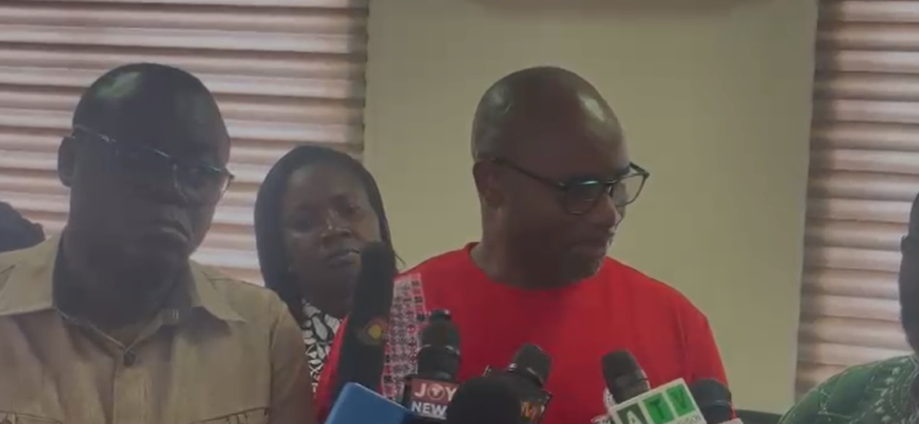
GNAT Head of Salaries Isaac Baah said the unions were no longer prepared to rely on verbal assurances and wanted the government’s commitments documented with clear timelines.
He specifically questioned assurances that payment of the Deprived Area Allowance would begin in January 2027.
“So what is the evidence? What has been put on paper? What is on paper to show that they will start paying the deprived area allowance by 2027? We want to see it. We want to see something documented,” he said.
Mr Baah also expressed concern about delays in concluding negotiations for a new Collective Agreement following the expiration of the previous agreement.
According to him, the delay has affected allowances that should have been paid to teachers in September.
“There are allowances that ought to be paid this month, September. And because it has expired, we’ve not concluded on it. And there’s no timeline for when we are going to finish with the negotiation,” he said.
He said government representatives indicated that timelines for concluding the negotiations would be presented at another meeting scheduled for Tuesday.
“They said when we meet on Tuesday, there will be timelines. So let us meet on Tuesday. They should give us a timeline. If we accept it, so be it,” he said.
Mr Baah indicated that the unions could reconsider the industrial action if the government presents a clear and acceptable timeline in writing.
He explained that a documented commitment to conclude negotiations by the middle or end of October, for instance, could be presented to union members for consideration.
“If we know that and it is on paper, and we bring it out, and everybody sees it, our constituents, the teachers, see that this is what we have on paper, definitely we’ll have no choice but to say that, oh, because of the way negotiations are going and where we’ve gotten to now, let us go back to the classroom,” he said.
“So it is not just by word of mouth. It is something that we have to see, something concrete.”
The unions’ position follows an appeal by Education Minister Haruna Iddrisu for teachers to suspend the strike while negotiations with the government continue.
At Monday’s meeting, Mr Iddrisu acknowledged the unions’ concerns but urged them to consider the effect of the industrial action on the academic calendar, particularly efforts to maintain the September-to-July school calendar.
The meeting involved GNAT, the National Association of Graduate Teachers (NAGRAT), the Pre-Tertiary Teachers Association of Ghana (PRETAG), the Controller and Accountant-General’s Department (CAGD) and the Fair Wages and Salaries Commission (FWSC).
GNAT, NAGRAT and PRETAG began their nationwide strike on September 25 after a September 24 deadline given to the government to address their concerns expired without a resolution.
Their demands include the conclusion of negotiations for a new Collective Agreement and the automatic placement of teachers who passed promotion examinations in December 2025 and February 2026 onto their appropriate salary scales.
The unions are also demanding the payment of arrears dating from January 2026 and the implementation of the Deprived Area Allowance for teachers working in deprived and hard-to-reach communities.
For now, GNAT maintains that teachers will remain away from the classroom until the government provides concrete evidence that their demands are being addressed.


