


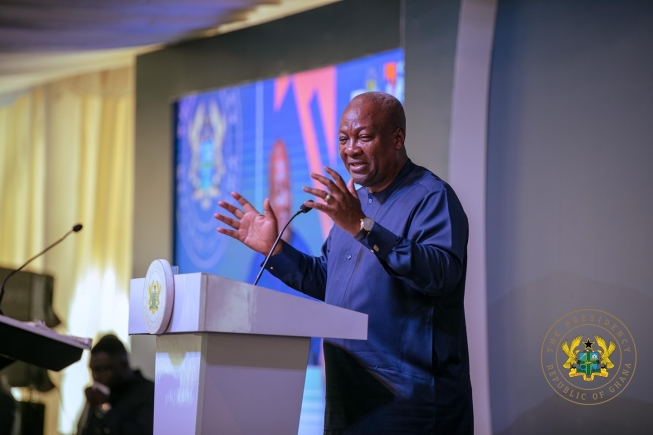
President John Dramani Mahama has called for a re-examination of how the transatlantic slave trade is remembered, arguing that the experiences of enslaved women and girls must be placed at the centre of discussions on historical justice and reparations.

Addressing heads of state, foreign ministers, scholars and members of the African diaspora, President Mahama said the global narrative on slavery has too often overlooked the unique suffering endured by women and girls during one of history’s darkest chapters.
“The historical experiences of women and girls cannot remain footnotes in the global narrative. They must occupy their rightful place at the centre of truth-telling, remembrance and redress,” he stated.
The President stressed that while millions of Africans suffered under the transatlantic slave trade, the burden of enslavement was not experienced equally. According to him, women and girls were subjected to distinct forms of violence, exploitation and abuse that have largely been omitted from mainstream historical accounts.
“As we reflect on this history, it is important to remember that the experience of enslavement was not borne equally by all who endured it,” he said.
President Mahama observed that historical records frequently focus on slave ships, merchants and trading companies while neglecting the human stories of those who suffered under the system.
“History remembers the names of the ships, the merchants and the trading companies. Yet far too often it forgets the woman whose body became a site of exploitation or the mother standing on the shore uncertain whether she would ever see her child again,” he noted.
He argued that for many enslaved women, exploitation extended far beyond forced labour, as their bodies became tools of economic extraction and instruments for sustaining the institution of slavery.
“For many enslaved women, exploitation did not end just with providing labour. Their bodies themselves became instruments of economic extraction,” he said.
The President further noted that enslaved women’s reproductive capacity was often exploited to perpetuate slavery across generations.
“Their capacity to bear children was transformed into a means of reproducing bondage across generations,” he added.
According to President Mahama, much of this suffering was excluded from official records, resulting in what he described as a form of historical erasure that continues to marginalise women’s experiences in global memory.
“Their suffering was often concealed from the official record, leaving them victims not only of the institution but also of historical erasure,” he stated.
He emphasised that correcting this imbalance requires acknowledging the critical role women played in resisting oppression and preserving families and communities under unimaginable conditions.
President Mahama paid tribute to renowned figures such as Nanny of the Maroons, Harriet Tubman and Sojourner Truth, describing them as symbols of resilience and resistance against oppression.
“From Nanny of the Maroons in Jamaica, whose story is believed to have begun on the shores of present-day Ghana, to Harriet Tubman and Sojourner Truth, women have been at the forefront of resistance against oppression,” he said.
He also honoured the countless unnamed women whose sacrifices helped sustain hope, families and communities throughout generations of enslavement.
“Their courage was matched by countless others whose names history has failed to record and yet whose sacrifices helped preserve families, communities and hope in the most difficult of circumstances,” he noted.
The President further acknowledged the contributions of contemporary women, including scholars, activists, jurists, policymakers and civil society leaders, whose work continues to advance the global reparations movement.
“We also honour the women of our time whose contributions have helped bring us to this historic moment and continue to shape the path that we must take ahead,” he said.
President Mahama concluded by stressing that any framework for reparatory justice must be gender-responsive and inclusive. He warned that efforts aimed at truth-telling, memorialisation and redress would remain incomplete if they fail to recognise the specific experiences of women and girls.
According to him, the global conversation on slavery must move beyond acknowledgement and embrace a more inclusive approach to historical justice that fully reflects the voices and experiences of those who have long remained on the margins of history.


