


The Ghana Education Service (GES) has dismissed concerns over a nationwide shortage of spaces in senior high schools, saying the country has enough capacity to accommodate students seeking admission for the 2026/27 academic year.

According to the GES, approximately 800,000 spaces are available for a little over 600,000 students seeking admission through the 2026 Computerised School Selection and Placement System (CSSPS).
Head of Public Relations at the GES, Daniel Fenyi, said the figures demonstrate that the difficulties being experienced by some parents and students are not the result of a shortage of places in senior high schools.
“In terms of spaces, we have well about 800,000 spaces for 600,000, a little over 600,000 students who want to pursue senior high education,” he said.
Mr Fenyi was speaking on Joy News’ PM Express on Monday amid growing frustration among parents and guardians over the placement process.
Automatic placements increase
He said the GES had recorded a significant improvement in automatic placements this year.
According to him, about 527,000 students were automatically placed in 2026, compared with 483,000 in 2025 and 447,000 in 2024.
“So if you ask me what changed, what changed is a significant improvement in the automatic placements that were done this year,” he said.
The GES official also noted a sharp decline in the number of students relying on self-placement.
He said about 107,000 students used self-placement in 2025, but the figure had dropped to approximately 53,000 as of September 10, with the registration process still ongoing.
Mr Fenyi said when automatic placements and self-placement are combined, between 93% and 95% of students have so far secured placements.
He explained that automatic placements accounted for about 87% of students, while the remaining 13% were expected to use the self-placement option.
GES rejects placement crisis claims
Mr Fenyi strongly rejected suggestions that the country is facing a nationwide crisis with the 2026 placement exercise.
“I want to emphasise, Evans, that if you have a system that has been able to place about 95% of the students through automatic and self-placement put together, you cannot, by any stretch of imagination, call such a 95% efficiency a crisis,” he said.
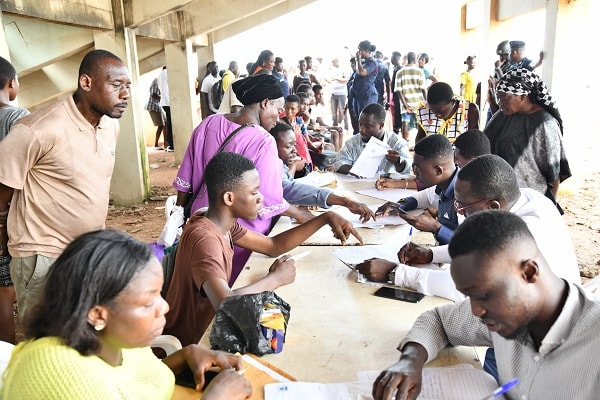
He said the outstanding cases were being addressed through 17 resolution centres established nationwide.
The centres are handling issues including human errors, technical challenges, placement shortfalls and other exceptional cases arising from the exercise.
“That’s why we have resolution centres. This year, there are 17 resolution centres nationwide, 17 of them,” he said.
Accra and Ashanti centres face pressure
Mr Fenyi acknowledged that some of the resolution centres in Accra and the Ashanti Region had been overwhelmed by the number of parents and students seeking assistance.
However, he cautioned against using the situation in the two regions as a measure of the overall performance of the placement system.
“Accra is not Ghana,” he stressed.
According to Mr Fenyi, 15 of the 17 resolution centres are operating smoothly, while only two have experienced significant pressure.
He therefore urged stakeholders not to interpret the challenges at those centres as evidence of a nationwide placement crisis.
“So let me assuage the fears of stakeholders who might be following these placement issues critically. If you have 17 places that are addressing issues, and 15 of them are running efficiently, you cannot say that the resolution centres or the placement itself has issues,” he said.


