


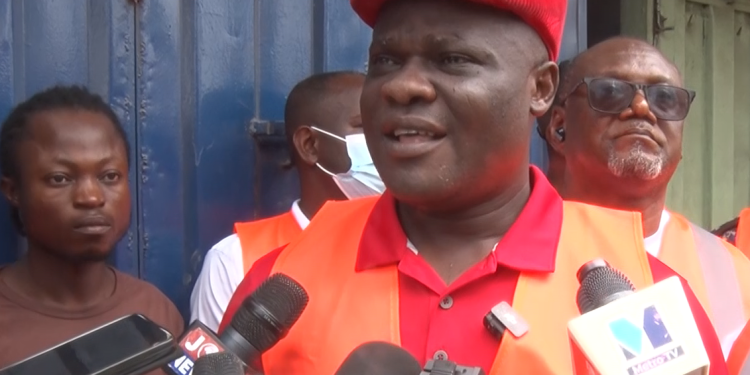
The Minister for Local Government, Chieftaincy and Religious Affairs, Ahmed Ibrahim, has rejected claims that Metropolitan, Municipal and District Chief Executives (MMDCEs) are responsible for the failure to desilt major storm drains, insisting that the responsibility rests with the Department of Urban Roads.

Speaking to JoyNews’ Fatau Bayaga at Alajo during the second day of the National General Clean-up Exercise on Saturday, July 11, the Minister said it was unfair to blame MMDCEs for choked storm drains when the mandate and funding for such works are assigned to the Department of Urban Roads.
He explained that Metropolitan, Municipal and District Assemblies (MMDAs) receive limited funding for sanitation, making it difficult for them to undertake large-scale desilting while also meeting their other sanitation obligations.
According to the Minister, only 10 per cent of the District Assemblies Common Fund is allocated to sanitation, leaving assemblies with insufficient resources to cover street sweeping, waste collection, drain maintenance and other sanitation services throughout the year.
“To say that the MMDCEs are sleeping on the job is something that I won’t take lightly. Because the responsibility of desilting drains and the storm drains is the responsibility of Urban Roads. Those monies go to Urban Roads. So how can you come and be insulting a DCE who is merely responsible for primary drains?” he said.
Mr Ibrahim questioned whether the funding allocated to district assemblies was adequate to meet the broad range of sanitation responsibilities expected of them.
“The amount given to my DCE for the 2025 first to fourth quarter was GH¢13 million. Ten per cent for sanitation is GH¢1.3 million. Can you use GH¢1.3 million for the entire sanitation work in my district for the whole year? Recruiting people to be sweeping, paying them, sending recyclables, etc. Can you use GH¢1.3 million for the whole year?” he asked.
The Minister urged the public to hold the appropriate institutions accountable for the desilting of major storm drains, stressing that such works should have been completed before the onset of the rainy season.
“That is the responsibility of Urban Roads. And Urban Roads should have done it before the rains set in, not the MMDCEs,” he stated.
His comments come amid renewed public scrutiny of flood mitigation efforts following recent flooding in parts of the Greater Accra Region and other areas of the country.
What the law says
Under Ghanaian law, responsibility for drainage infrastructure is shared between national agencies and local assemblies.
The Ghana Hydrological Authority Act, 2022 (Act 1085) mandates the Ghana Hydrological Authority to plan, design, execute, operate and maintain flood control systems and drainage improvement works. Major storm drains also fall under the technical jurisdiction of the Department of Urban Roads.
Meanwhile, the Local Governance Act, 2016 (Act 936), particularly Section 181 and the First Schedule, assigns Metropolitan, Municipal and District Assemblies responsibility for constructing and maintaining inner-town and community drains, as well as enacting bye-laws to regulate sanitation and waste management within their jurisdictions.


