


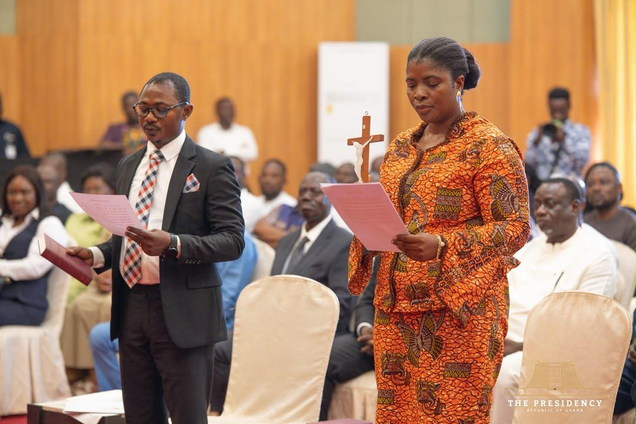
Presidential staffer Beatrice Annan has defended the appointment of Emelia Afi Agbenyo as Deputy Chairperson of the Electoral Commission (EC), arguing that participation in political campaigns does not automatically establish partisan allegiance or undermine electoral neutrality.

Agbenyo’s appointment, alongside that of Dr Joseph Kweku Asamoah as another Deputy Chairperson, has attracted criticism from the opposition New Patriotic Party (NPP), which has questioned her suitability for the position.
The party has cited her involvement in the National Democratic Congress (NDC)’s campaign activities and her role as a spokesperson for the party’s manifesto committee on governance as grounds for concern about her impartiality.
However, her supporters have pointed to her professional background in gender advocacy and policy work, including her experience as a technical adviser and gender analyst with GIZ Ghana.
They argue that her participation in the NDC’s 2020 and 2024 election campaigns was driven by efforts to promote women’s representation in leadership rather than formal membership of the governing party.
Her defenders have also cited her reported criticism of the NDC in 2016 over governance concerns and her warning ahead of the 2024 elections that gender advocates could campaign against the party if it failed to retain a female running mate.
They maintain that these positions demonstrate that her political engagement has been shaped by specific policy concerns, particularly gender equality and women’s participation in leadership.
Presidency defends appointment process
Speaking on Citi FM on Monday, October 12, 2026, Ms Annan insisted that Agbenyo had never been a card-bearing member of the NDC and had not demonstrated any conduct suggesting she would be biased in the discharge of her duties.
“She has not done anything to demonstrate any potential bias or imminent bias,” she said.
Ms Annan also maintained that the presidency followed the constitutionally prescribed procedure in making the appointments.
According to her, the nominees were presented to the Council of State more than a month before their swearing-in, allowing the council to undertake consultations with relevant stakeholders.
The controversy has renewed debate over the qualifications and perceived political neutrality of Electoral Commission officials, particularly the extent to which past political engagements should influence public confidence in their ability to administer elections impartially.


