


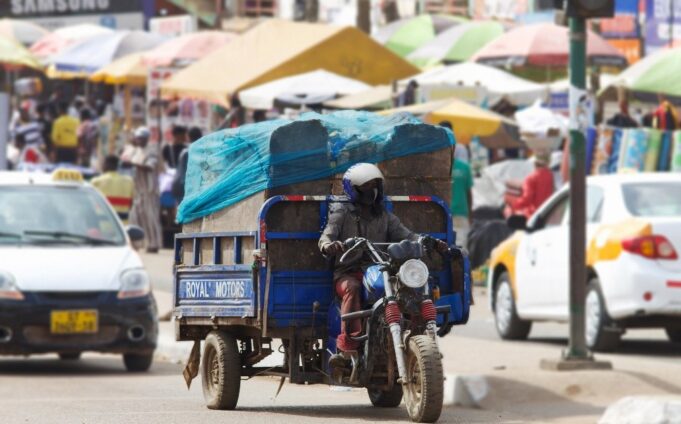
The President of the Chamber for Local Governance, Richard Fiadomor, has blamed some tricycle operators, popularly known as Aboboya, for the growing number of illegal waste-dumping sites in Accra and other major cities.

According to him, some operators dispose of collected waste at unauthorised locations instead of designated landfill sites, worsening sanitation challenges in urban communities.
Speaking on Joy FM‘s Super Morning Show on Wednesday, July 8, during a discussion on Ghana’s sanitation challenges, Mr Fiadomor explained that Metropolitan, Municipal and District Assemblies (MMDAs) engage licensed private waste management companies to provide sanitation services within designated areas.
“The assemblies will enter into a franchise agreement with the waste management operator to operate within a demarcated area within a particular MMDA. The assembly will come up with a fee-setting resolution so that the private company will not charge arbitrarily for the services they are going to render to the citizens. They can charge less than that but not above what the assembly has approved,” he said.
Mr Fiadomor, however, noted that many households now prefer the services of Aboboya operators because they charge lower fees than the approved franchise operators.
He said this has made it more difficult to ensure that waste is transported to authorised disposal sites.
“Some citizens who have used the services of these franchise companies have now, quote and unquote, fallen in love with these Aboboya operators who are undercutting the prices of their services far less than the fee-setting resolution approved by the assembly. So what do we see? Much of the waste is carried by these Aboboya collectors; unfortunately, they do not have what it takes to go to the long distances where some of the landfill sites are located,” he said.
According to Mr Fiadomor, some operators dump waste illegally under the cover of darkness, making it difficult for city authorities to detect and prosecute offenders.
“They take the waste, sometimes they find their way in the night when you and I are asleep, and they dump it anywhere and go back,” he said.
“Some citizens have decided to use the services of the Aboboya collectors, and once they’re doing that, they are paying less, and they are okay with it. Those Aboboya people are now the ones creating the problems,” he added.
Mr Fiadomor attributed a significant portion of the sanitation crisis, particularly the proliferation of illegal dumping sites, to the practices of some Aboboya operators.
His comments come amid growing concern over the increasing number of illegal waste disposal sites in Accra and other urban centres, which have exposed nearby communities to potential health risks, including disease outbreaks.
The issue has also gained renewed attention following recent flooding in parts of the capital, during which large volumes of waste were swept through floodwaters, raising fresh concerns about the impact of poor sanitation on public health and urban resilience.


