


Story By: Dennis Ato Keelson, COP30 Belem, Brasil, Courtesy Jospong Group of Companies.

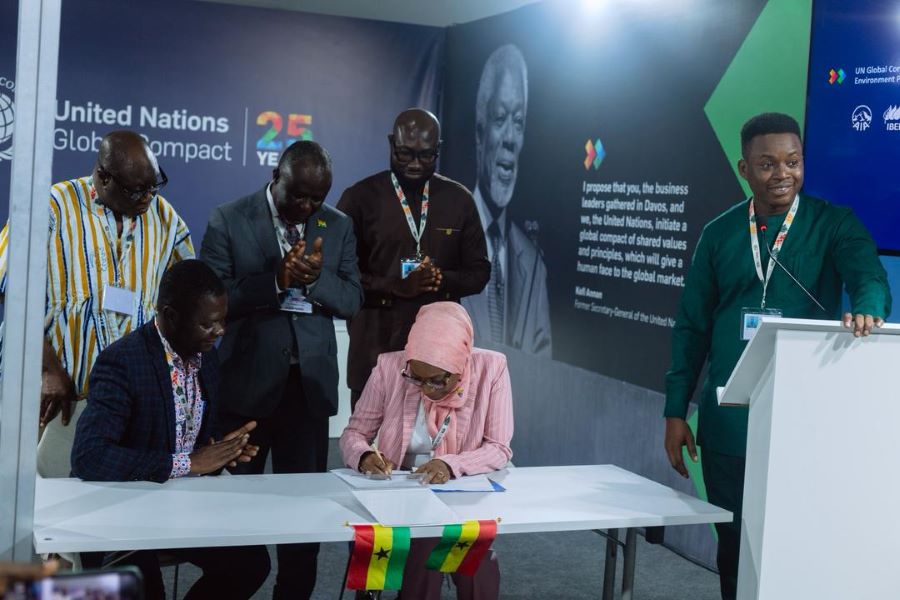
The Jospong Group of Companies has signed a groundbreaking Memorandum of Understanding (MoU) with the United Nations University Institute for Natural Resources in Africa (UNU-INRA) on the sidelines of the COP30 summit at Belém, Brasil, marking a major step towards translating climate research into tangible action for the continent.
The signing ceremony, which took place at the UN Global Compact Pavillion, part of the COP30 Exhibition, on Monday, November 17, 2025, will see the Ghanaian conglomerate’s practical expertise in waste management and agriculture fused with UNU-INRA’s research prowess to drive green industrialization, build climate resilience, and empower small-to-medium enterprises (SMEs) across Africa.
The General Manager of the Jospong Group Green Transition Office, Dr. Glenn Kwabena Gyimah, signed for the group, while the Director of UNU-INRA, Professor Fatima Denton, represented the university.
The event was witnessed by key members of the Parliamentary Select Committee on Environment, Science, and Innovation, who included Chairman Yaw Frimpong Addo, his Vice, John Darko, and the Ranking Member, Dr. Adam Hamza.
Speaking at the ceremony, Dr. Gyimah described the partnership as a pivotal step in the group’s sustainability mission, underscoring the strategic importance of the collaboration.
“As a group, we drive sustainability in an integral order. Sustainability is now a market that drives economies, and we are particular about it,” he noted.
The partnership, he explained, was being formed to drive growth, investments, create jobs, and have an impact in our world, stressing “This MOU signing is a privilege, and we’ll hear about the outcome in the coming time.
For her part, Professor Denton underscored the critical need for such a partnership, indicating that green businesses were essential.
She however, lamented that many African entrepreneurs were not inclined towards green business, despite its importance.
“The infrastructure is often not there. The technology is absent. The resources are not there,” she further bemoaned.
She elaborated on the synergy between the two institutions, explaining that while Jospong was very action-oriented in waste management, agriculture, and green transition, the UN Institute was research-oriented.
The partnership would leverage their strengths, combining Jospong’s practical experience with the UN Institute’s research expertise to support Africa, she added.
Professor Denton also contextualised the agreement within the larger, often frustrating, context of COP negotiations.
“When we come to the COP, the conversations that I had are very much geared towards decarbonisation. It doesn’t mean we don’t want decarbonisation. We want decarbonisation that’s fair, decarbonisation that’s inclusive,” she stated, emphasising the need for a “fair deal” for Africa that includes finance and technology transfer.
The Ranking Member on Parliament’s Environment Committee, Dr. Hamza, praised the initiative for bridging “the gap between theory and practice, academia and industry.”
He urged both parties to ensure the partnership delivers concrete results, saying, “Don’t let it end up like many other partnerships that fail to deliver.”
He assured them of parliamentary support, adding, “As members of Parliament, we’ll do our best to support this partnership, especially when it comes to policy and legislation. We’ll stand ready to ensure its success.”
Earlier, in a welcome address, a Senior Sustainability Officer at Jospong Green Transition Office, Dr. Gloria Kusi Boamah, set the tone, stating, “This memorandum of understanding symbolises more than cooperation; it represents a shared vision, a vision where research informs action, where technology and policy work hand in hand, and where African institutions lead the transformation towards sustainability.”
What the MoU Stands to Achieve
The partnership is designed as a practical engine for Africa’s just transition. It will pursue joint research, capacity building, and high-impact projects focused on strengthening climate resilience, advancing natural resource management, and supporting green industrialisation.


