


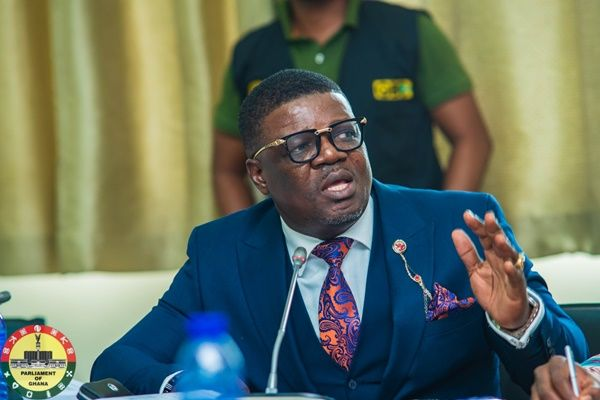
Majority Chief Whip Rockson-Nelson Dafeamekpor has defended the government’s proposed tribunal bills, insisting they are intended to improve the administration of justice and should not be compared to the tribunals that operated during the Provisional National Defence Council (PNDC) era.

Speaking on PM Express on JoyNews on Monday, July 13, Mr Dafeamekpor acknowledged public concerns about tribunals but argued that Ghana’s judicial system has undergone significant reforms since the Fourth Republic.
“This perceived apprehension about the tribunal system is quite deeply rooted. But it’s been dealt with by text writers, by judicial decisions, by the reforms that we’ve seen over the years,” he said.
He explained that the tribunals established under PNDC Law 78 were fundamentally different from those that formed part of Ghana’s judicial system under the 1992 Constitution.
According to him, the key feature of the tribunal system was public participation in the administration of justice through legally qualified chairpersons sitting alongside two lay members.
“The only difference was we infused the participation of the public, of the people,” he said, adding that the approach reflects the constitutional principle that justice emanates from the people.
Mr Dafeamekpor likened the arrangement to Ghana’s jury system, where ordinary citizens assist judges in determining serious criminal cases.
Tracing the history of the tribunals, he noted that reforms introduced in 2002 abolished community and circuit tribunals within the lower courts and replaced them with district and circuit courts. However, he said regional tribunals were retained in the Constitution and were never formally abolished.
He recalled appearing before the Greater Accra Regional Tribunal as a young lawyer after graduating in 2009, adding that the system gradually became inactive around 2010 when then Chief Justice Georgina Wood stopped empanelling regional tribunals.
Mr Dafeamekpor argued that the Judiciary continues to face growing caseloads despite the expansion of district courts and specialised High Courts across the country.
He said the proposed legislation seeks to operationalise constitutionally recognised regional tribunals and establish additional tribunals to complement existing courts, particularly in handling specialised offences.
According to him, the tribunals will focus on cases involving illegal mining, environmental crimes, economic and financial offences, tax and customs violations, narcotics offences, damage to property and the use of public office for personal gain.
He said the aim is to ensure faster resolution of cases, especially prosecutions related to illegal mining.
“The cry has been that the regular courts are unable to deal with it… People are interested in the express delivery of handling of the matter,” he said.
Mr Dafeamekpor also outlined timelines contained in the proposed legislation, stating that accused persons would enter an appearance within seven days of being served, pre-trial proceedings would begin by the 10th day, trials by the 15th day, proceedings would conclude by the 21st day, and judgment would be delivered within 42 days.
He maintained that hearings would generally proceed on a day-to-day basis, subject to the court’s discretion to grant adjournments where necessary.
Responding to concerns about involving ordinary citizens in criminal adjudication, the Majority Chief Whip argued that public participation strengthens confidence in the justice system.
“In fact, it’s actually the best system of adjudication in any criminal trial,” he said, comparing the proposal to the jury system in the United States, where peers help determine criminal cases.
He concluded that the proposed tribunals are consistent with the Constitution and are intended to improve efficiency in the delivery of justice rather than revive the tribunal system associated with the PNDC era.


