


Story By: Dennis Ato Keelson

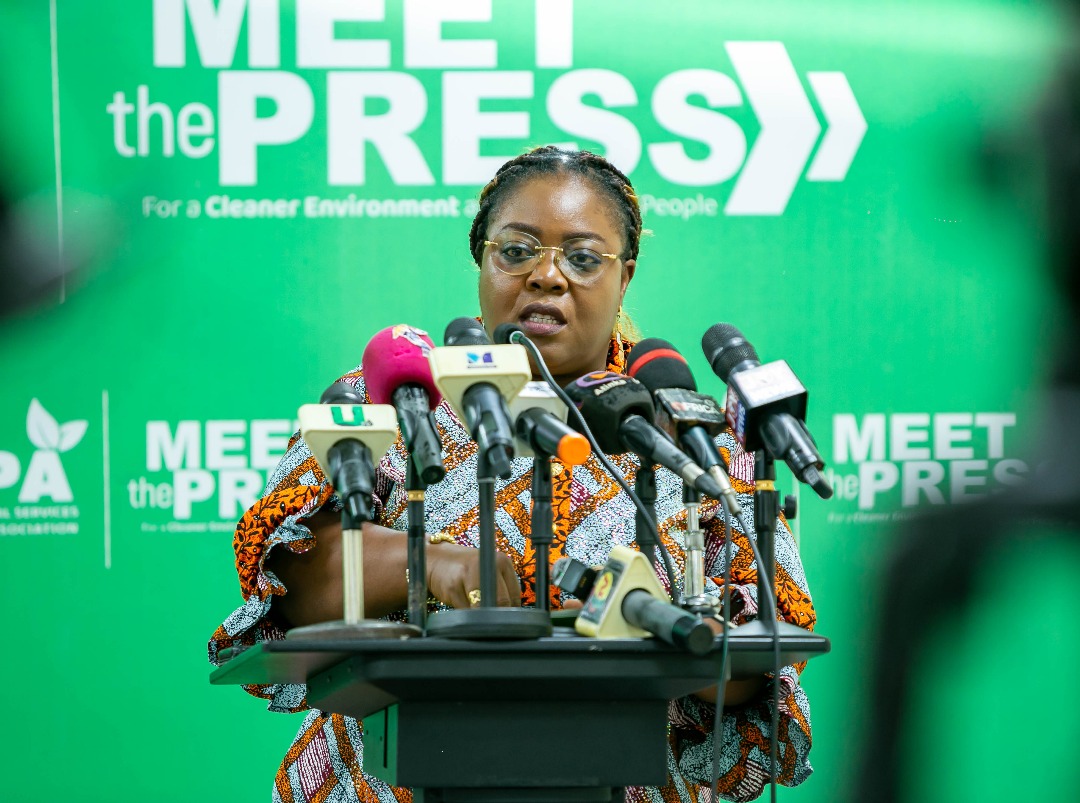
The Environmental Service Providers Association (ESPA) has given government a seven-day ultimatum (by November 7, 2025,) to settle all outstanding payment owed its members, failure of which they will be compelled to shut down their operations nationwide.
Addressing a crowded news conference in Accra on Wednesday, October 29, 2025, the Executive Secretary of ESPA, Madam Ama Ofori Antwi, said “we therefore appeal to the Government for the immediate release of outstanding payments owed to all waste management contractors by 7th November, 2025.”
She lamented that despite ESPA engaging he Ministry of Local Government Chieftaincy and Religious Affairs, as well as relevant parliamentary committees, to facilitate payment to its members, their situation remained same.
“Unfortunately, these efforts have yielded little progress. However, we call on the government to as a matter of urgency make payment to avoid shutdown by the 7th November, 2025,” she warned.
According to her, a nationwide shutdown by service providers is a recipe for a national sanitation and health emergency.
“This measure, if taken, would lead to the outbreak of disease such as cholera, typhoid, malaria, etc.,” she further cautioned.
According to the Executive Secretary of ESPA, Ghana’s waste management sector was saddled with an alarming state of operational and financial distress of which members of ESPA were not left out.
She disclosed that waste collectors, transporters, and transfer station operators continue to grapple with unprofitable and unfair fee rates fixed by the Metropolitan, Municipal, and District Assemblies (MMDAs).
These rates, she stressed, did not reflect the real cost of service delivery, making operations of ESPA members economically unsustainable.
“The situation has been further compounded by the lack of access to functional treatment and disposal sites, many of which are in deteriorated condition due to poor maintenance. As a result, waste collection and transportation activities have become highly inefficient, costly, and unprofitable for service providers, threatening the overall sustainability of Ghana’s waste management system,” Madam Ofori Antwi bemoaned.
In addition, she indicated that several critical waste management facilities, including landfill sites, solid waste treatment plants, transfer stations, and wastewater treatment facilities were struggling to stay functional under mounting financial pressure.

“Rising operational costs in fuel, electricity, labour, and maintenance, coupled with high energy tariffs, inadequate revenue inflows, high cost of capital, and long delays in service payments, have pushed the sector to the brink,” she said.
In wake of the above, Madam Ofori Antwi averred that that immediate government attention and intervention were necessary, however, caution that that if not provided, could compound the challenges and thus could cripple Ghana’s waste management system.
She also used the opportunity to call on MMDAs to review the current fixed cost recovery rates paid to waste collectors, transporters, and transfer station operators.
She explained that this stemmed from the fact that the existing rates have become economically unsustainable, rendering operations unprofitable for many members.
“A fair and realistic adjustment is essential to ensure business viability and the continued provision of effective sanitation services across the country,” she pointed out.
Furthermore, “We call on the Metropolitan, Municipal, and District Assemblies (MMDAs) to review the current fixed cost recovery rates paid to waste collectors, transporters, and transfer station operators. The existing rates have become economically unsustainable, rendering operations unprofitable for many members. A fair and realistic adjustment is essential to ensure business viability and the continued provision of effective sanitation services across the country.”


