


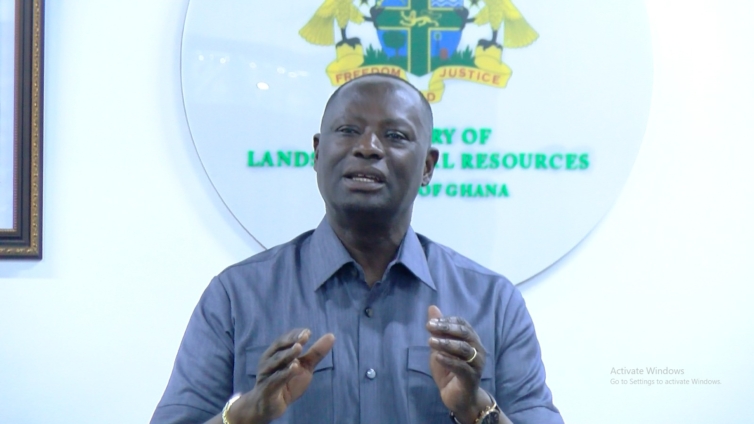
The Minister for Lands and Natural Resources, Emmanuel Armah-Kofi Buah, has admitted that securing convictions is one of the major obstacles facing Ghana’s crackdown on illegal mining, even as hundreds of suspects have been picked up and thousands of equipment impounded.

Mr Buah said 258 people had been arrested in raids targeting illegal mining in forest reserves as of July 2026, but noted that the real test was making sure those arrested were taken through the courts successfully.
“The challenge we are having is not the arrest. It is the prosecution.”
The Minister revealed this during a policy dialogue with the IMANI Centre for Policy and Education in Accra, where he outlined government’s current measures against illegal mining, popularly called galamsey.
The forum was organised to review the Ministry’s inherited problems, ongoing reforms and policies in the mining sector.
Prosecution Gap
Although the Ministry gave figures on arrests and confiscations, it did not provide details on how many suspects have been charged, prosecuted, convicted, acquitted or have cases still pending.
Mr Buah said the Ministry was collaborating with the Attorney-General’s Department to fix the prosecution bottlenecks. The admission exposes a major weakness in the government’s anti-galamsey drive, where enforcement is yielding high arrest numbers but uncertainty remains over what happens to suspects in the justice system.
According to Ministry data, as of July 2026, 200 excavators had been seized and 34 others disabled, while 1,469 water pumps and 950 changfan machines were confiscated. An additional 1,259 water pumps and 774 changfans were also disabled. Officials further seized 48 tricycles, 285 motorbikes, 82 gold detectors and disabled 801 structures during the forest reserve operations. The numbers point to the volume of machinery being used for illegal mining and the scale of the enforcement task facing authorities.8,900 Hectares of
Forest Reserves Destroyed
Mr Buah also revealed that roughly 8,900 hectares of forest reserves have been totally destroyed by illegal mining and other harmful activities. Nine forest reserves were listed as the hardest hit, with the Minister noting that some areas were now hard for Forestry Commission staff to enter due to illegal miners, violence and weapons. He said previous estimates of the damage were too low because they relied on outdated data. He added that restoring the destroyed areas will demand huge resources.
Over 4,000 Excavators Held at Ports
Government is also targeting illegal mining by controlling excavator imports. Mr Buah disclosed that more than 4,000 excavators are currently held at the ports awaiting clearance under a new documentation system. Under the policy, importers must state the importer’s details, intended user and the exact location where each excavator will work before it is released.
The Minerals Commission now has officers stationed at the ports for the process. Cleared excavators will be fitted with trackers and locked to their declared operational zones using geofencing. Government expects the system to make every excavator in Ghana traceable in future.
Government Targets Galamsey Supply Chain
The Ministry is also focusing on the supply network behind illegal mining. Of the equipment seized or disabled, 1,724 changfan machines were involved. Mr Buah said many of these machines are built locally before being moved to mining sites and water bodies. That brings into focus the people and companies manufacturing, funding and supplying equipment used for illegal mining.
About 2,000 Blue Water Guards have also been deployed as community intelligence and first responders around affected water bodies. Mr Buah admitted there were discipline issues within the programme, including reports that some guards took bribes, but insisted the initiative was producing results.
Mining Reforms
Beyond enforcement, government is proposing changes to Ghana’s mining licensing system. Mr Buah said the initial duration for large-scale mining leases will be cut from 30 years to 20 years under the new framework. Government also plans to place tougher requirements on holders of exploration and prospecting licences to show real work within set timelines.
He condemned the practice of firms holding concessions for years without serious exploration or development. The Ministry is additionally proposing District Mining Committees to give communities more input on mining applications and to review impacts on water bodies, farms and settlements before licences are granted.Mining firms will also be mandated to sign community development agreements to define their responsibilities to host communities.
The Real Test Is Prosecution and Results
The latest figures show the scale of government’s anti-galamsey operations, but the prosecution gap remains the key hurdle.Government has arrested 258 suspects, seized or disabled hundreds of excavators and thousands of other machines, while about 8,900 hectares of forest reserves have been confirmed as completely degraded.How these cases are handled in court will decide whether the ramped-up enforcement can deliver a lasting deterrent against illegal mining.


