


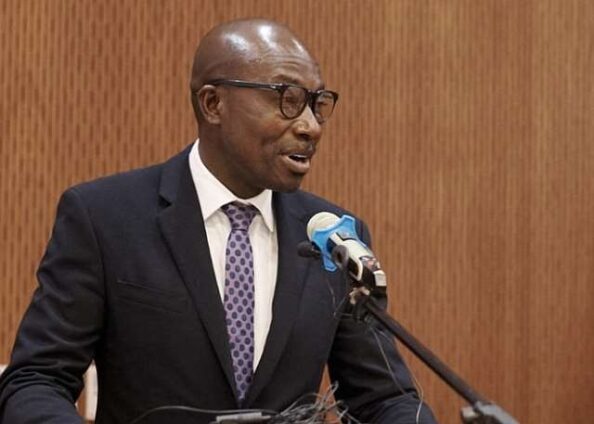
The Ghana Bar Association has strongly rejected allegations by government spokesperson Felix Kwakye Ofosu that the association is aligned with the opposition New Patriotic Party (NPP), describing the claims as disappointing and politically divisive.

The controversy follows growing public debate over the GBA’s initial silence regarding comments made by Minority Leader Alexander Afenyo-Markin against a judge handling the case involving NPP Bono Regional Chairman Kwame Baffoe, popularly known as Abronye DC.
Speaking on Joy FM’s Top Story on Monday, the Public Relations Officer of the GBA, Saviour Kudze, criticised attempts to politicise the legal profession whenever the association comments on national issues.
“That doesn’t come as a surprise. It’s rather disappointing that every time this matter keeps coming up,” Mr Kudze stated.
He argued that Ghana faces far more pressing national concerns than recurring partisan accusations against professional bodies.
“It appears the many problems that Ghanaians are worried about — sanitation, galamsey — we don’t want to act on those ones. Anytime GBA speaks at certain times, he speaks for certain people, and he doesn’t speak for certain people,” he said.
The backlash emerged after Mr Kwakye Ofosu suggested in a Facebook post that the GBA’s silence on Mr Afenyo-Markin’s comments reinforced longstanding perceptions that the association sympathises with the NPP — allegations the association has repeatedly denied over the years.
Responding to the accusation, Mr Kudze said reducing the Ghana Bar Association to partisan affiliations undermines both the legal profession and national democratic discourse.
“How long can we continue to do this? It’s becoming a ritual. Can we move away from this?” he asked.
He further challenged political leaders to focus on addressing institutional concerns rather than engaging in public attacks on professional bodies.
“In any case, all those or most of those people saying these things are in leadership. If they have identified a problem, understanding of leadership is providing solutions to problems. What have they done about it?” he questioned.
Mr Kudze stressed that the GBA remains a unified body representing lawyers from all political backgrounds.
“Because it is only one group of lawyers that we have. We are all lawyers belonging to one group. If there’s an issue, how do we deal with it?” he said.
He firmly dismissed claims that the association operates in the interest of any political tradition.
“Every time, GBA is a wing of NPP. I don’t know that. To me, it is not true,” he added.
At the same time, the GBA condemned the public comments made by Mr Afenyo-Markin against the judiciary, describing them as inappropriate and damaging to judicial independence.
Mr Kudze stated that the association would never condone conduct by lawyers that undermines judges or public confidence in the judiciary.
“We will never condone such conduct. Over the years, we have consistently cautioned and condemned similar behaviour by lawyers,” he said.
“I will not mince words in saying that what the Minority Leader, a senior lawyer at the Bar, has done is condemnable at every level. A senior lawyer who also holds a public position ought to have done better,” he added.
The controversy stems from remarks made by Mr Afenyo-Markin during a press conference on Sunday, May 17, 2026, where he criticised the continued remand of Abronye DC and questioned the handling of the case.
“What has been done to Abronye DC is a profound constitutional wrong, and must be condemned without equivocation, without delay,” he stated.
He further argued that prosecuting a citizen over comments made publicly amounted to political persecution rather than justice.
However, his strongest criticism was directed at the presiding judge.
“That Circuit Court 9 judge – I have no respect for him. I pray he summons me for contempt. I will continue to disrespect him until he upholds the law. It’s a shame on the judiciary; he doesn’t talk law,” Mr Afenyo-Markin declared.
The remarks have since sparked widespread debate over judicial independence, freedom of expression and the responsibilities of lawyers and public officials in commenting on ongoing legal proceedings.


