


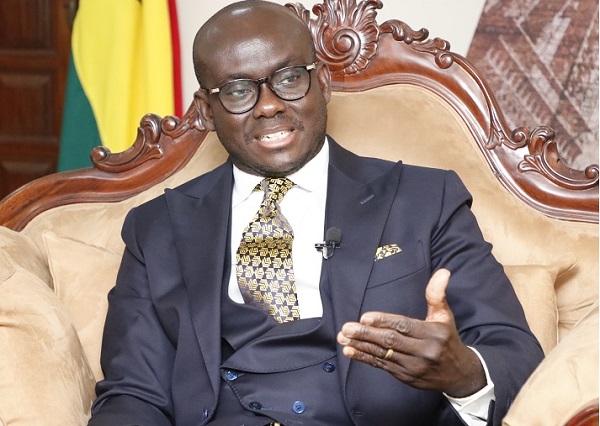
Former Attorney-General and Minister of Justice Godfred Dame has questioned why Manhyia South MP and lawyer Nana Agyei Baffour Awuah was kept in the custody of the Economic and Organised Crime Office (EOCO) for two nights without bail.

Mr Dame made the comments in a statement on Saturday following the MP’s arrest and detention in connection with an investigation into alleged GH¢2.2 million in legal fees.
Baffour Awuah’s detention followed an earlier attempt by EOCO officials to arrest him at the Accra High Court on September 23.
The MP described that encounter as an unlawful arrest and alleged that an EOCO official attempted to take him into custody. EOCO, however, said the attempted arrest formed part of lawful steps to secure his attendance for questioning in an ongoing investigation.
The dispute subsequently escalated, with the High Court issuing a warrant for Baffour Awuah’s arrest after EOCO said it had exhausted reasonable means of securing his voluntary attendance.
The MP later reported himself to EOCO on October 1, accompanied by his lawyers and fellow Members of Parliament.
Mr Dame has now questioned the decision to keep the legislator in custody for two nights.
“On what account does Nana Agyei Baffour Awuah (MP) spend 2 nights in EOCO custody without bail when being investigated for a ‘transaction’ from which he earned legal fees of GhC 2.2M?” he asked.
He also questioned whether the conduct under investigation constituted a criminal offence.
“In any event, are the issues raised from his conduct in the matter criminal?” he asked.
Dame cites previous cases
Mr Dame compared the treatment of Baffour Awuah with cases involving former ministers and a Member of Parliament under the previous administration.
He cited former Minister Alhaji Collins Dauda, who, according to Mr Dame, was granted self-recognisance bail and “never spent a single day in custody” despite facing trial over an alleged financial loss of about US$198 million.
He also referenced former Deputy Finance Minister Cassiel Ato Forson, saying he was granted self-recognisance bail without spending a day in custody despite facing trial over offences valued at €2.3 million.
Mr Dame further cited Dr Dominic Ayine, saying he was granted bail in 2017 and did not spend a day in custody while being investigated over his role in the Ameri deal.
Mr Dame argued that the handling of Baffour Awuah’s case reflected what he described as a wider problem with the use of state investigative and prosecutorial powers.
“It is correct to say that the investigative and prosecutorial authority of certain state institutions is being utilised to punish political opponents and settle parochial scores,” he said.
He also criticised what he described as the prioritisation of political opponents over organised crime.
“Meanwhile, real organised and economic crime like the narcotic trade reigns supreme in Ghana. The investigative bodies are busily chasing political opponents and suppressing free speech,” he said.
Mr Dame concluded by describing what he considers the use of state power in this manner as a serious concern for law enforcement.
“The deployment of state power to settle scores and punish political opponents is the lowest point of law enforcement,” he said.


