


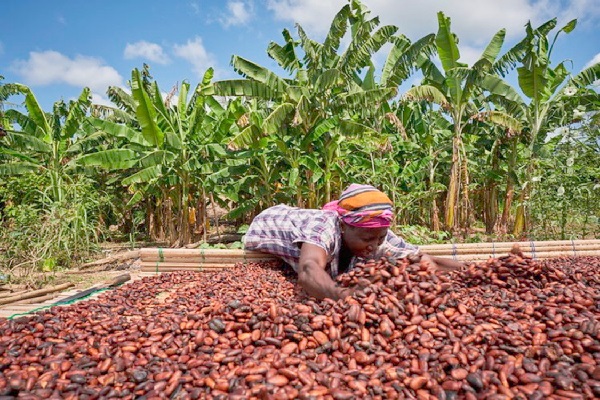
The government has decided to maintain cocoa producer prices despite a downturn in international cocoa markets, a move aimed at protecting the incomes and livelihoods of Ghanaian farmers, according to the Head of Public Affairs at the Ghana Cocoa Board, Jerome Sam.

Speaking on JoyNews’ PM Express on Monday, Mr Sam said the decision reflects Ghana’s long-standing approach to cocoa pricing and contrasts with practices in neighbouring Côte d’Ivoire, where producer prices are adjusted in response to fluctuations in global cocoa prices.
Ghana’s Pricing System Designed for Stability
Mr Sam explained that Ghana’s cocoa pricing framework traditionally provides stability for farmers throughout the season.
“This is a conventional thing, and it has been a practice all this while. At the beginning of the season, an official announcement will come, and then when we also get to the light crop season, there will also be an announcement,” he said.
According to him, producer prices announced at the start of the season often remain unchanged until the season ends, offering farmers predictability and protection from market volatility.
“Oftentimes, the price at the beginning remains unchanged because of the system adopted by Ghana,” he noted.
Earlier Price Adjustment Triggered by Exceptional Circumstances
Mr Sam acknowledged that unusual developments in the cocoa sector over the past year compelled authorities to review prices earlier than expected.
“It is quite unfortunate. Something happened this year. Starting from the beginning of last year, which goes into this year, something happened, so we had to have a change in the price somewhere in February,” he explained.
He said the adjustment generated considerable public debate but was necessary to safeguard an industry that remains a major contributor to Ghana’s economy.
“Government and COCOBOD took that decision just to save a sector which significantly contributes to our GDP,” he stated.
Farmer Welfare Was the Key Consideration
According to Mr Sam, the government’s overriding concern in maintaining the current producer price was the welfare of cocoa farmers.
“Government took into consideration the income levels of the ordinary farmer. That is basically the first thing government took into consideration,” he said.
He revealed that if authorities had strictly followed prevailing international market conditions, cocoa producer prices would likely have been reduced again.
“If we are to consider what is prevailing on the international market, then of course the price would have gone down again,” he noted.
Different Approach from Côte d’Ivoire
Drawing comparisons with Côte d’Ivoire, where he was speaking from at the time, Mr Sam explained that producer prices there are adjusted whenever global cocoa prices rise or fall.
“Should you come to Côte d’Ivoire, where I find myself today, that’s what is happening, because they are having changes as and when the prices dip,” he said.
Ghana, however, chose to shield farmers from another reduction.
“We took a decision that the farmer has already been hit, so we need to make sure that the prices remain unchanged, so we can end the season,” he explained.
Balancing Protection and Sustainability
Mr Sam stressed that while government is focused on protecting cocoa farmers, it is equally committed to ensuring the long-term sustainability of the cocoa sector.
“Inasmuch as we are protecting the farmer, we are also ensuring a sustainable sector which will continue to play that major role in the lives of the farmers, as well as the economy,” he stated.
He reiterated that concerns about the welfare and financial wellbeing of cocoa farmers ultimately shaped the government’s decision.
“I can tell you that the government was largely very concerned about the income and livelihood of the ordinary cocoa farmer,” Mr Sam added.


