


The International Monetary Fund (IMF) has urged Ghana to fully utilise the fiscal space created through recent economic reforms and stabilisation efforts to drive strategic investments and create jobs.

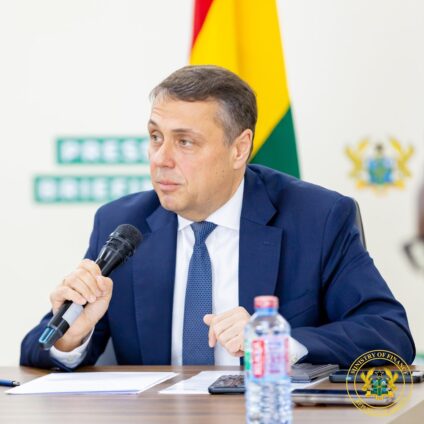
The call was made on Friday, May 15, by Ruben Atoyan, IMF Chief Mission for Ghana, during a joint briefing with the Ministry of Finance in Accra after a Staff-Level Agreement was reached on the sixth review under the Extended Credit Facility (ECF) arrangement.
The briefing also marked the conclusion of Ghana’s 2026 Article IV Consultation and the successful completion of the country’s three-year US$3 billion IMF-supported programme. Ghana will now transition into a new 36-month Policy Coordination Instrument.
Mr Atoyan described Ghana’s economic recovery and fiscal turnaround as “remarkable,” noting that the country now has the opportunity to channel the benefits of its reforms into sustainable growth and employment creation.

“The fiscal space is ultimately the space the Government generated through strong policies and can now be used to support economic growth, employment, and strategic investment in key sectors,” he stated.
Despite the progress, the IMF official warned that Ghana must carefully manage two major risks as it moves from economic stabilisation to growth — maintaining fiscal discipline and managing exposure to fluctuations in gold prices.
He called for stricter expenditure controls, especially among state-owned enterprises (SOEs), recommending the use of public-private partnerships while avoiding spending outside the central government’s budget framework.
Mr Atoyan also cautioned against overreliance on current gold prices, noting that commodity markets remain highly unpredictable amid global geopolitical uncertainty. He urged the government to use the current favourable conditions to build stronger economic buffers.
Meanwhile, Ghana’s Minister of Finance, Cassiel Ato Forson, said the country’s next phase of economic management would focus on stability, resilience, and development.
“Stability will build resilience, and then we will use that resilience to develop. Clearly, stability has been achieved, and it has been confirmed by the Fund. It is now time for us to develop and create jobs,” he said.
Dr Forson further revealed that the government would soon unveil a flagship development strategy known as the “new economy,” aimed at driving development and expanding employment opportunities across key sectors.
“From stability, we will build resilience, and from resilience, we will build an economy that benefits the masses,” he added.


