


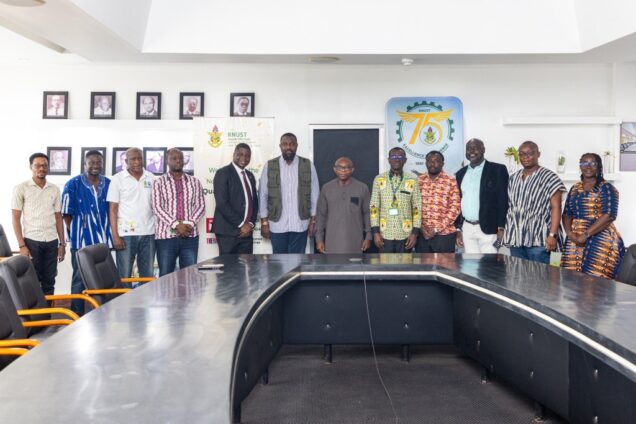
The Kwame Nkrumah University of Science and Technology (KNUST) is set to collaborate with the Ministry of Food and Agriculture to develop locally manufactured farming equipment and technologies aimed at reducing Ghana’s reliance on imported machinery.

Vice-Chancellor of KNUST, Professor Christian Agyare, gave the assurance when he received the Deputy Minister for Food and Agriculture and Member of Parliament for Ayawaso West Wuogon, John Dumelo, at his office.
Mr Dumelo said the Ministry undertakes significant procurement each year and argued that more government contracts should be directed towards innovative solutions developed by Ghanaian universities.
“We should be able to change the norm to allow most of our university students to come up with designs that we can expand on to reduce importation,” he said.
He said the long-term objective was to increase the adoption of locally developed technologies in government projects, particularly in the agricultural sector, where inadequate machinery and mechanisation continue to pose significant challenges.
The Deputy Minister also proposed that KNUST’s engineering departments take the lead in designing and manufacturing agricultural machinery and tools that could be deployed to farmers across the country.
Responding to the proposal, Professor Agyare described it as “a laudable initiative” that aligns with his vision of positioning KNUST as a key contributor to national development.
“This aligns with the University’s strategic vision of strengthening partnerships that enable KNUST to translate its expertise and research into practical solutions,” he said.
He directed relevant departments to engage with Mr Dumelo to identify areas of mutual interest, particularly in agricultural mechanisation.
KNUST Explores Locally Made Traffic Lights
The meeting also explored a second area of collaboration involving the development of locally manufactured traffic-light systems for the Ayawaso West Wuogon Constituency.
Leading the KNUST delegation, Professor Eric Tutu Tchao, Scientific Director of the DIPPER Lab at the College of Engineering, said discussions had focused on a proposed project to improve traffic-light systems in the constituency.
According to Prof Tchao, the project would require collaboration between the College of Engineering and the College of Science, with university experts providing the technical expertise needed to address traffic management challenges.
Mr Dumelo recalled that traffic-light systems had previously been developed by KNUST students during his time at the university and expressed interest in reviving the initiative.
“We would like to explore the possibility of engaging KNUST students and faculty to design and manufacture systems that could be deployed within the constituency,” he said.
He noted that the initiative could eventually serve as a model for other constituencies and be replicated across the country.
Professor Agyare assured the Deputy Minister of KNUST’s full support and technical capacity to implement both projects.
The DIPPER Lab will lead the technical implementation of the traffic-light project in collaboration with experts from the College of Engineering and the College of Science.
The proposed partnerships are expected to strengthen collaboration between academia and government while promoting the development and adoption of locally engineered solutions in agriculture, transportation and other sectors.


