


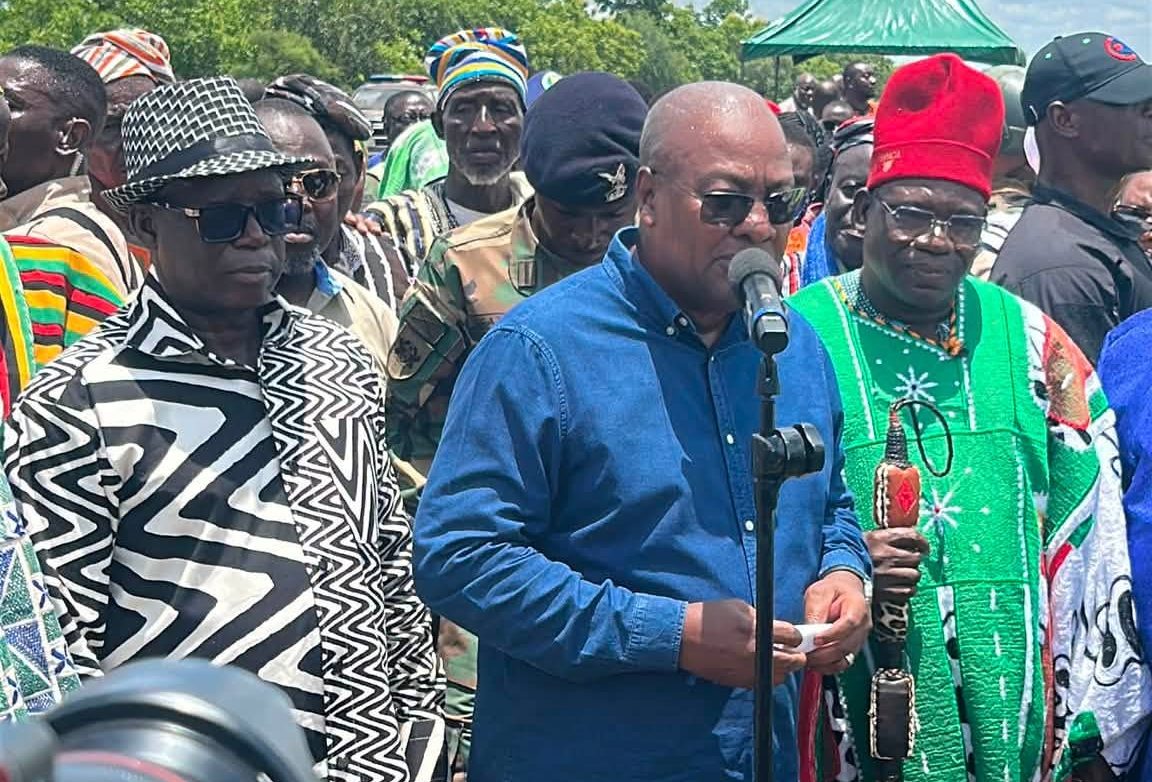
President John Dramani Mahama has announced plans to expand Ghana’s pharmaceutical manufacturing capacity as part of efforts to reduce the country’s dependence on imported medicines.

The President said the government had received a five-year strategic plan aimed at increasing domestic production of medicines, achieving greater self-sufficiency and creating opportunities for Ghana to export pharmaceutical products to neighbouring countries.
He made the announcement at a Free Primary Health Care (FPHC) programme in Zuarungu in the Bolgatanga East District.
President Mahama disclosed that about 70 per cent of medicines currently used in Ghana are imported, despite the country having the capacity to manufacture many of the products locally.
“We import 70 per cent of the drugs that we use. But we have the capacity to produce those drugs here ourselves,” he said.
According to the President, the plan was presented by the National Vaccine Institute, the Ministry of Health, the Pharmaceutical Association of Ghana and other relevant institutions.
He said expanding local pharmaceutical production would help reduce the cost of medicines and strengthen the government’s ability to provide affordable treatment under the FPHC programme.
“If we can do that, it will allow us to procure the drugs at a cheaper cost. And that makes it easier for us to provide more of these medications to our people at a primary health care level,” he said.
Government Secures Medicine Supply
President Mahama said that while efforts were being made to expand local manufacturing, the government had entered into agreements with pharmaceutical companies to ensure that essential medicines remained available to patients.
He specifically mentioned medicines used to manage hypertension and diabetes, including metformin and other prescribed drugs.
The President also outlined measures to strengthen the National Health Insurance Scheme (NHIS), saying the government had uncapped funding for the scheme and was making timely payments to healthcare providers.
He said NHIS tariffs had also been reviewed to better reflect the actual cost of healthcare services.
“As a result, there should be no co-payment at any health facility. Because we fully covered the cost of treatment,” he said.
President Mahama urged health facilities participating in the NHIS to comply with the policy and refrain from demanding additional payments from patients for services covered by the scheme.
Investment in Specialist Healthcare
The President further highlighted investments under the Ghana Medical Trust Fund to support patients suffering from serious conditions, including cancer, cardiovascular diseases and renal failure.
He said the government was also equipping major hospitals with specialist diagnostic and treatment infrastructure, including CT scanners and catheterisation laboratories.
According to President Mahama, a cardiothoracic facility under development in Tamale would provide advanced treatment for patients in the northern parts of the country, reducing the need for patients to travel long distances to access specialised care.
He said the combined measures were intended to improve access to healthcare, strengthen the country’s health system and reduce the financial burden of illness on households.
“Health is wealth. You need a healthy population to be able to make a wealthy nation,” he said.
President Mahama was accompanied by the Minister of Health, Kwabena Mintah Akandoh; Attorney-General and Minister for Justice, Dr Dominic Akurutinga Ayine; Minister of State for Government Communications, Felix Kwakye Ofosu; and Minister of State for Public Sector Reforms, Lydia Lamisi Akanvariba.
Other officials on the delegation included Mahama Ayariga, Member of Parliament for Bawku Central; Minister for Education, Haruna Iddrisu; his Deputy, Dr Clement Abas Apaak; James Agalga, MP for Builsa North; and Dr Thomas Winsum Anabah, MP for Garu, among other government officials.


