


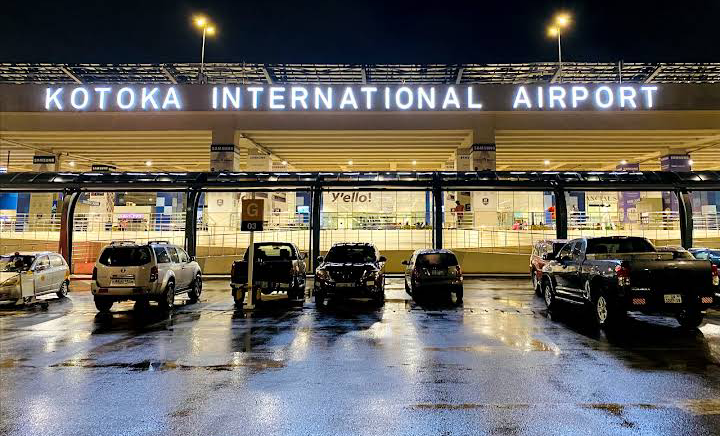
The Attorney-General (A-G) has told the Supreme Court that Kotoka International Airport remains the legal name of Ghana’s international airport, as the legislative process to rename it Accra International Airport has not been completed.

The position forms part of the government’s response to a suit filed by Austin Kwabena Brako-Powers, who is seeking a declaration that the proposed renaming is unconstitutional because the government has not first amended the General Kotoka Trust Decree, 1969 (NLCD 339).
The plaintiff’s case centres on whether the government can lawfully proceed with the name change while the decree establishing the General Kotoka Trust remains in force.
The A-G maintains that the decree remains operative and that the proposed renaming must be approved by Parliament before it can take legal effect.
In an affidavit of evidence deposed to by Mamavi Owusu-Aboagye, an Assistant State Attorney in the Civil Division of the Office of the Attorney-General, the government said the renaming process was still ongoing. It argued that the public announcement of the proposed change did not, by itself, alter the airport’s legal name.
The government referred to a paragraph in Exhibit AG8, which outlines the steps required to implement the renaming, including changes to statutory instruments, official documents, airport signage, digital platforms and aviation publications.
According to the affidavit, the reference to further statutory changes demonstrates that the process had not been legally completed through the press release announcing the decision.
The A-G further stated that the Accra International Airport Bill, 2026, had been prepared, received Cabinet approval and been signed by the Minister for Transport. The Bill, it said, was ready to be laid before Parliament in accordance with the legislative process.
Kotoka Trust Decree remains in force
The Attorney-General maintained that the government had neither amended nor repealed the General Kotoka Trust Decree, 1969 (NLCD 339).
“The General Kotoka Trust Decree, 1969 (NLCD 339) remains fully intact and operative as part of the laws of Ghana. The airport’s legal name under Ghanaian law continues to be Kotoka International Airport,” the affidavit stated.
The government also denied interfering with the trust established in honour of the late General Emmanuel Kwasi Kotoka.
It said no beneficiary had been deprived of any benefit and that no obligation under the trust had been rendered unenforceable.
Government outlines approval process
The affidavit outlined the steps taken towards the proposed renaming, beginning with the submission of a draft Accra International Airport Bill, 2025, to the Ministry of Transport on August 21, 2025.
The government requested that the Ministry forward the draft Bill to Cabinet for consideration and approval before it was presented to Parliament.
On November 10, 2025, the Ministry of Transport formally sought Cabinet’s policy approval through a memorandum proposing the name change and the introduction of legislation in Parliament.
Cabinet approved the proposal on December 9, 2025, with the decision formally communicated to the Attorney-General on January 23, 2026.
The Minister for Transport signed the Bill on February 10, 2026, after which it was prepared for presentation to Parliament.
Attorney-General challenges Supreme Court’s jurisdiction
In its statement of case, the Attorney-General argued that the Supreme Court lacked jurisdiction to hear the suit because the plaintiff had not raised a genuine question of constitutional interpretation or enforcement.
It contended that the plaintiff’s complaint concerned an alleged violation of NLCD 339, which it described as a statutory rather than constitutional matter.
“The Plaintiff’s true grievance is that NLCD 339, a statutory instrument, has been or is about to be violated. That is a statutory question, not a constitutional one, and no genuine issue of constitutional interpretation or enforcement arises,” the statement of case read.
The A-G also argued that the action was premature because the Bill had not yet been laid before Parliament.
It said granting the injunctions sought by the plaintiff would halt the legislative process before Parliament had an opportunity to consider the proposed law.
“For this Court to grant the injunctive reliefs sought by the Plaintiff would be for the judiciary to arrest a legislative process at the very threshold of Parliament before Parliament has had any opportunity to exercise its constitutional role,” the statement read.
The case remains pending before the Supreme Court.


