


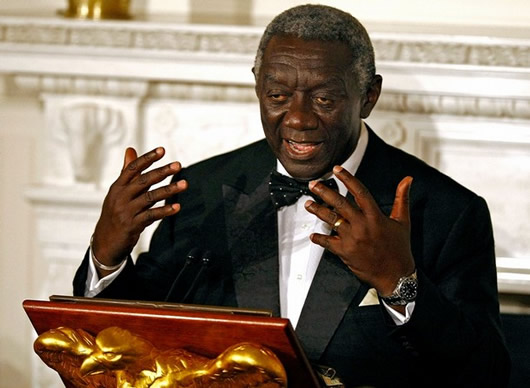
Former President John Agyekum Kufuor has called for a major review of public sector salaries in Ghana, arguing that low wages for government officials contribute significantly to corruption.

Speaking in an interview on the AM Show, Mr Kufuor said the current salary structure for civil servants and political office holders is unrealistic and can create conditions where corruption becomes a coping mechanism.
He said improving governance requires paying public servants competitively while enforcing strict penalties for those who engage in corrupt practices.
Mr Kufuor referenced the approach of former Singaporean leader Lee Kuan Yew, who argued that ministers and senior government officials should be paid salaries comparable to top corporate executives to attract and retain highly qualified professionals in public service.
“The people I used to fashion these policies are as good as the people in the corporate world getting fat salaries — so they must be paid like the people in the corporate world,” he quoted Lee Kuan Yew as saying.
According to Mr Kufuor, Ghana’s top political offices are significantly underpaid compared to the level of responsibility and expertise required.
However, he stressed that higher salaries must be accompanied by strict accountability measures.
“When you choose to be in the public sector, to be well-paid, and you allow yourself to be tempted into corruption and they catch you, some of the worst punishments should be visited on you,” he said.
Debate about public sector pay in Ghana has continued for years, particularly after the introduction of the Single Spine Salary Structure in 2010, which aimed to address wage disparities across the public sector.
Critics, however, say the policy has not fully resolved concerns about fairness and competitiveness in government pay.
Mr Kufuor, who served as president from 2001 to 2009 under the New Patriotic Party (NPP), said Ghana needs a comprehensive rethink of how it compensates public servants if the country wants to reduce corruption and improve efficiency in public administration.


